

Stablecoin supply shifts are not a measure of liquidity, they are a measure of how long capital can afford to remain uncommitted. When supply expands, participants are choosing flexibility over exposure, even while remaining inside the market. When it contracts, that flexibility disappears, and capital becomes structurally tied to positions it cannot easily exit. The shift itself is not directional, it reflects a change in constraint. Markets do not move when capital becomes available, they move when capital loses the ability to wait.
Stablecoin supply shifts signal capital intent, not just liquidity
Stablecoins are often described as idle liquidity, but in practice, they represent postponed risk. Holding stablecoins is not neutral positioning, it is an active refusal to engage until conditions justify exposure.
When supply increases, it rarely reflects new conviction entering the market. More often, it signals that existing capital has stepped out of risk while remaining within reach of re-entry. This creates liquidity that is present but strategically inactive, capital that is observing structure rather than participating in it.
When supply decreases, that layer disappears. Capital is no longer positioned to react, it must absorb price movement. This transition matters because committed capital cannot exit without cost, and that cost begins to shape market behavior.
Recent sessions have shown that even during periods of elevated stablecoin supply, price can remain compressed for extended periods. This is not a lack of liquidity, it is liquidity choosing not to engage.
Expansion phases reflect hesitation disguised as readiness
An expanding stablecoin supply is often interpreted as latent demand, but this assumes that capital is waiting to act rather than waiting to decide. In reality, expansion phases tend to align with periods where exposure is reduced without clarity replacing it.
Over the past week, similar conditions have shown that participants rotate into stablecoins during moments where directional conviction weakens, but uncertainty remains unresolved. Capital does not leave the system, it pauses within it.
This creates a structurally inefficient environment:
- Liquidity exists, but avoids commitment
- Price reacts, but fails to extend
- Participation increases, but conviction does not
In these phases, markets can appear active while remaining directionally stagnant. Movement occurs, but it lacks continuation because the capital required to sustain it is still withheld.
Markets do not stall because liquidity is absent, they stall because liquidity refuses to accept risk at current levels.
Contraction phases reveal when capital commits
When stablecoin supply contracts, capital transitions from optional to exposed. This is the point where positioning replaces observation.
Recent sessions have shown that contraction phases tend to align with more persistent price movement, not because demand suddenly increases, but because previously flexible capital becomes structurally involved. Once deployed, that capital cannot adjust without consequence, it becomes part of the market’s inertia.
This changes the mechanics of price behavior:
- Flexibility is replaced by obligation
- Liquidity becomes embedded within the trend
- Price movement becomes harder to interrupt
Price doesn’t move because more buyers appear, it moves because fewer participants remain able to step aside.
Stablecoin behavior must be read alongside market structure
Stablecoin supply shifts only become meaningful when aligned with how liquidity is positioned and accessed, particularly when viewed alongside derivatives positioning stress. On their own, they describe movement. Within structure, they explain pressure.
Institutional participants do not deploy capital instantly. Large positions require careful execution to avoid slippage, which means capital often sits in stablecoins while orders are distributed across time, venues, and instruments. This introduces a hidden layer of behavior that is not visible through supply alone.
Market makers play a central role in this process, with their market maker timing behavior determining when liquidity is made available and when it is withheld. They adjust spreads and available liquidity based on expected flow, meaning that capital cannot always enter the market at will, it must wait for conditions where execution becomes efficient. Stablecoin expansion, in this context, can reflect preparation rather than hesitation.
This is where retail interpretation diverges:
- Retail sees available liquidity
- Institutions see execution constraints
Markets are not driven by how much capital exists, but by how safely that capital can be deployed without disrupting price, a dynamic often visible through liquidity depth signals.
The illusion of “dry powder” in crypto markets
Stablecoins are often framed as unused buying power, but this assumes that all capital is equally deployable. In practice, most of it is conditional, constrained by liquidity depth, timing, and execution risk.
Recent sessions have shown that large pools of stablecoin liquidity can coexist with stagnant price action. This is not inactivity, it is selectivity. Capital is present, but it is waiting for conditions where participation does not create adverse outcomes.
Capital does not chase opportunity – it waits until opportunity becomes structurally necessary.
This reframes stablecoin supply entirely:
- It is not a measure of demand
- It is a measure of delayed commitment
- It reflects how long capital can remain patient under uncertainty
What the current structure suggests
Stablecoin supply should be interpreted through sequencing rather than absolute levels. Expansion and contraction are not signals on their own, they are phases within a broader behavioral cycle.
Current market conditions suggest that extended periods of expansion without corresponding volatility reflect unresolved positioning. Capital remains present but unconvinced, waiting for conditions that justify exposure.
When contraction begins after prolonged expansion, it often marks a transition where waiting becomes inefficient. At that point, capital is forced to engage, not because conditions are ideal, but because remaining uncommitted carries its own risk.
This transition is subtle, but decisive. It does not appear through indicators – it emerges through behavior.
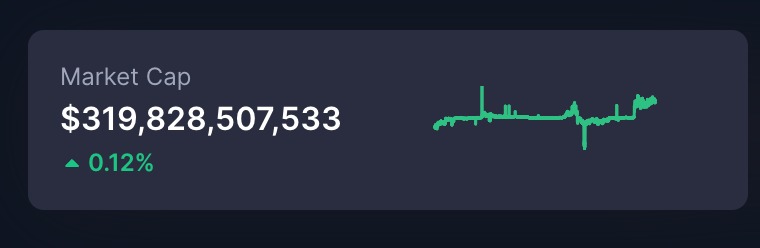
The 1-month chart reflects a sequence between delayed participation and forced engagement rather than isolated price movement. Periods of compression often align with phases where stablecoin supply expands, indicating that liquidity is accumulating without influencing price. Expansion tends to occur only after this phase breaks, not when liquidity is highest, but when it begins to convert into exposure. This reinforces a structural pattern: markets move when capital stops preserving flexibility and starts accepting risk.
Editor’s View: Stablecoins expose the limits of patience
Stablecoin supply shifts are less about future demand and more about how long participants can delay being wrong. Expansion reflects a market that still has the capacity to wait, where capital can remain uncommitted without immediate consequence. Contraction begins when that capacity erodes, when staying out of the market introduces more risk than participating in it. This is why stablecoins do not lead price, they reveal when avoidance is no longer sustainable.
Conclusion
Stablecoin supply shifts do not tell you where the market is going, they tell you how participants are positioned relative to uncertainty. Expansion reflects a market that is unconvinced, while contraction reflects a market that is no longer able to wait. The transition between these phases is where structural change occurs, not because new information appears, but because existing capital is forced to act. In this sense, stablecoins are not a liquidity metric, they are a behavioral map of when patience turns into participation.
Suggested Links
Keep yourself updated with the latest crypto analysis with Blockbuzzed
Keep yourself updated with the latest news around Altcoins with Blockbuzzed

