
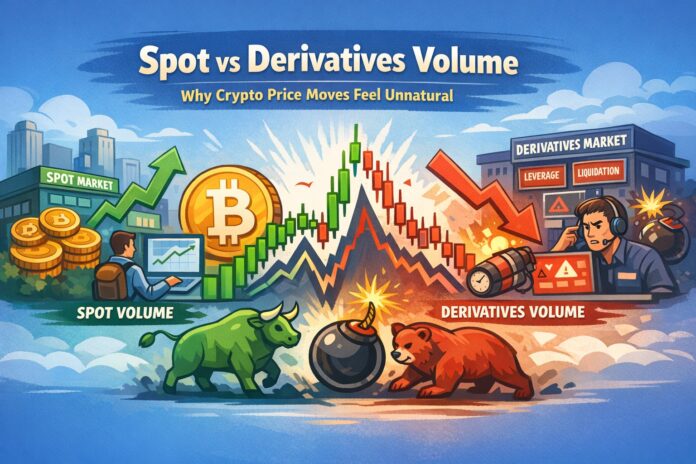
Spot vs derivatives volume is not just a comparison of trading activity. It is a signal of which force is actually controlling price: real ownership or leveraged exposure. Most participants assume price reflects buying and selling. In reality, it often reflects the stress created by positioning. When those two diverge, the market stops behaving intuitively and starts behaving as a system under pressure.
Recent sessions have shown price pushing higher in short bursts while spot participation remained relatively muted. Over the past week, similar behavior has appeared across major assets, where moves developed quickly but struggled to hold structure. That kind of price action is not built on conviction. It is built on imbalance.
Price does not move because demand is strong. It moves because the market runs out of resistance.
Spot Volume Reflects Real Demand
Spot markets represent actual ownership transfer. When capital enters spot, it changes who holds the asset and at what cost basis. This matters because it directly reshapes supply.
Strong participants do not chase price. They absorb it. Their activity is less visible in the short term but more meaningful over time. As supply is absorbed, the market becomes structurally tighter. Price does not need to be forced higher. It moves because there is less available to sell.
Current market conditions suggest that when spot demand is present, price tends to stabilize even after sharp moves. This is because ownership has shifted into stronger hands that are less reactive.
The key detail is often missed: spot demand builds structure, not momentum.
Derivatives Volume Creates Synthetic Pressure
Derivatives markets introduce a different mechanism entirely. They allow participants to express size without committing equivalent capital, which fundamentally alters how quickly positioning can build.
Leverage compresses time. Exposure can scale faster than real capital flows, which means price can move before ownership changes.
But the deeper impact is not speed. It is obligation.
Derivatives positions must be maintained. They are subject to margin, liquidation thresholds, and funding costs. This creates a layer of forced behavior inside the market.
Recent sessions have shown how quickly price reacts once positioning becomes crowded. Moves accelerate not because new participants are entering, but because existing participants are being forced to adjust.
The market is not reacting to belief. It is reacting to pressure.
When Derivatives Dominate, Price Stops Behaving Normally
The imbalance between spot and derivatives volume is where most misinterpretation begins.
When derivatives dominate, price becomes sensitive to positioning shifts rather than underlying demand. Moves develop not because the market agrees on direction, but because it cannot sustain its current exposure.
Over the past week, multiple moves across Bitcoin and Ethereum have followed this pattern. Breakouts occurred without sustained follow-through, and reversals appeared before any clear distribution. This behavior reflects positioning being cleared, not trends being built.
What looks like momentum is often just imbalance resolving.
This leads to a different type of price behavior:
- Moves accelerate without accumulation
- Breakouts lack structural support
- Reversals occur before trend formation
The market does not move to reward conviction. It moves to remove pressure.
Liquidity Determines Whether Pressure Becomes Movement
Positioning alone is not enough to move price. It requires liquidity conditions that allow that pressure to translate into movement.
This becomes clearer when you look at liquidity depth across the market, where thin order books reduce resistance and allow even moderate positioning to move price disproportionately.
Liquidity is not just depth. It is the willingness of participants to absorb flow.
When that willingness disappears, even small imbalances can move price significantly. This is where order book behavior becomes critical. Thin liquidity means fewer resting orders. With less resistance, price travels further with less effort.
Recent sessions have shown how quickly price can move through low-liquidity zones, particularly during periods of compressed volatility. These moves are not driven by strength. They are driven by absence.
Price does not rise because buyers are aggressive. It rises because sellers are not present in sufficient size to contain it.
Positioning Imbalance Is What Actually Drives Price
Price is often treated as the primary signal, but it is the result of something deeper: positioning density.
When positioning becomes crowded, the market loses flexibility. It becomes dependent on those positions holding. The moment they cannot, price adjusts rapidly to rebalance.
This is where liquidation risk becomes embedded into the structure itself.
A heavily long market does not need sellers to decline. It only needs longs to reduce exposure. A heavily short market does not need buyers to rise. It only needs shorts to exit.
Current market conditions suggest that many sharp moves are not initiated by new capital, but by existing capital being forced to reposition.
The fastest moves in crypto are not driven by conviction. They are driven by constraint. This is the same dynamic seen when derivatives positioning stress builds, where funding rates begin to reflect how crowded and unstable positioning has become.
Market Makers Respond to Structure, Not Sentiment
Market makers operate within this system by managing execution risk, not by predicting direction.
Their role is to provide liquidity, but that liquidity is conditional. When positioning becomes one-sided, continuing to absorb flow increases risk. Holding price steady in the face of imbalance becomes expensive.
This is central to understanding how market makers control timing, where price is allowed to move only when maintaining balance becomes more expensive than releasing it.
At a certain point, it becomes more efficient to allow price to move than to continue containing it.
This is a critical institutional behavior most participants overlook.
Large players do not move price arbitrarily. They respond to when the market becomes structurally inefficient to hold in place. When derivatives positioning builds to an extreme, allowing price to move clears risk and restores balance.
This is why sharp expansions often follow quiet, compressed conditions. The pressure builds gradually, but the release is immediate.
Why These Moves Feel Unnatural to Most Traders
The disconnect comes from expectation.
Most traders expect price to reflect intent. They look for buying to explain strength and selling to explain weakness. But in a derivatives-driven market, price reflects obligation.
Recent sessions have shown strength appearing without visible accumulation and weakness emerging without clear distribution. This creates confusion because the visible inputs do not match the outcome.
The market is not reacting to what participants want to do. It is reacting to what they are forced to do.
Once that is understood, price behavior becomes less random and more mechanical.
Spot Still Decides What Lasts
Despite the influence of derivatives, sustainability still depends on spot demand.
Derivatives can initiate movement, but they cannot anchor it. Once positioning resets, price returns to areas where real demand exists.
Over the past week, several sharp moves have failed to hold once derivatives pressure eased. Without spot participation, there is no structural support.
This is the key distinction:
Derivatives move price. Spot determines whether it stays.

A 1-month Bitcoin price chart often reflects this structure clearly. Sharp directional moves tend to cluster in short timeframes, followed by stabilization or retracement. These bursts are rarely the result of steady accumulation. They are typically driven by positioning being forced to unwind in low-resistance conditions, with price overshooting before returning to areas supported by real demand.
Editor’s View
Most participants try to interpret markets through price, but price is the final expression of a deeper system.
What matters is how much pressure exists beneath it and how capable the market is of absorbing that pressure. When that capacity disappears, movement becomes inevitable, not because something new entered the system, but because something existing could no longer be sustained.
The idea that markets move purely on demand is incomplete. They move when imbalance reaches a point where it cannot be contained.
Understanding spot vs derivatives volume is not about comparing two metrics. It is about recognizing when the market shifts from participation to pressure.
Conclusion
Markets do not become unpredictable when derivatives dominate. They become mechanical.
Price stops reflecting interest and starts reflecting constraint. Movement accelerates not because conviction increases, but because flexibility decreases.
Once that shift occurs, the question is no longer who is buying or selling. It is who is able to hold their position and who is not.
That is where real market behavior is revealed.
Suggested Links
Keep yourself updated with the latest crypto analysis with Blockbuzzed
Keep yourself updated with the latest news around Bitcoin with Blockbuzzed

