

Bitcoin ETF flows are often interpreted as direct buying pressure, but that assumption overlooks how institutional demand is actually expressed. ETF inflows represent intent, not execution. Capital has entered the system, but its impact depends on whether the market can absorb it without adjusting price.
Recent sessions have shown that even steady inflows can coincide with narrow price ranges, reinforcing that demand can exist without immediate expression.
Markets do not react to capital entering. They react to capital that cannot be quietly placed.
Why ETF inflows do not immediately move price
When capital enters a Bitcoin ETF, it does not translate into immediate spot buying. The process is mediated by authorized participants and market makers, who create exposure while managing execution risk.
The sequence is not linear:
- ETF inflow is recorded
- Exposure is created through internal liquidity channels
- Market makers hedge positions gradually
- Execution is aligned with available liquidity
This aligns with how execution timing is controlled by liquidity providers, a dynamic explored in how crypto market makers control timing.
At an institutional level, execution is constrained by visibility. Large participants cannot interact aggressively with the order book without forcing price to move against them. As a result, they fragment execution across venues, using derivatives to hedge and OTC channels to source liquidity without signaling intent.
This creates a gap between demand and price.
Retail demand moves directly through the order book. Institutional demand avoids it until it has no alternative.
This reflects how execution timing is controlled rather than reactive, a mechanism explained in detail in how crypto market makers control timing.
Internal liquidity absorbs more demand than the market shows
Recent sessions have shown that strong ETF inflows can coincide with muted price action. This is not a contradiction. It reflects how effectively liquidity providers manage imbalance.
Market makers operate across:
- Spot exchanges
- OTC desks
- Derivatives markets
This allows them to internalize flow, matching buyers and sellers without pushing price through visible liquidity. The objective is not to express demand, but to manage inventory while minimizing impact.
This absorption dynamic becomes clearer when viewed through how liquidity is structured across the market, as explained in Bitcoin liquidity depth signals.
What sits beneath this is a constraint-based system. Liquidity providers continuously hedge exposure to avoid accumulating directional risk. As long as they can offset positions efficiently, demand remains contained.
This containment is only possible because of how liquidity is distributed across levels, a structure explored in Bitcoin liquidity depth signals.
Price does not move because buyers are active. It moves because the system can no longer absorb them.
When ETF flows start to matter for price
ETF flows begin to influence price when absorption capacity weakens. This is not defined by the size of inflows, but by the condition of liquidity and the willingness of participants to warehouse risk.
Over the past week, periods of tighter ranges have suggested that liquidity has been sufficient to contain incoming flow. However, these conditions are not stable.
The shift occurs when:
- Order book depth thins
- Market makers reduce balance sheet exposure
- Hedging becomes less efficient
- Execution begins to spill into visible markets
When this happens, internalization breaks down. Flow that was previously absorbed begins to impact price directly.
The shift often coincides with positioning stress, similar to what is seen in crypto funding rates positioning stress.
What changes is not demand. It is the market’s ability to manage it without consequence. This transition often overlaps with positioning imbalances building beneath the surface, similar to what is seen in crypto funding rates positioning stress.
The timing mismatch is what creates confusion
One of the most misunderstood aspects of Bitcoin ETF flows is timing. There is often a delay between inflow and visible price movement because execution is intentionally distributed.
This delay exists because:
- Hedging is spread across time and instruments
- Liquidity conditions evolve after inflows occur
- Exposure is built without immediate pressure on spot markets
As a result, markets often show:
- Strong inflows with limited immediate movement
- Later price expansion that appears disconnected
In reality, these are stages of the same process. First, the market absorbs. Then, it adjusts.
Current market conditions suggest that this lag is structural rather than incidental. ETF flows are not failing as a signal. They are simply arriving before the market is forced to respond.
What ETF flows actually reveal about institutional behavior
ETF flows are not a short-term signal. They are a positioning signal.
They reveal:
- Where capital is entering the system
- How consistently institutions are allocating
- Whether exposure is building over time
But they do not reveal:
- Immediate execution pressure
- Short-term direction
- Precise timing of moves
What they show is commitment without urgency.
This reflects how institutional capital behaves under constraint. Execution quality matters more than speed, so exposure is built gradually and often invisibly. Market makers facilitate this process by managing risk across instruments, allowing demand to exist without immediate price impact.
ETF flows show where capital is positioning. Price shows when positioning becomes impossible to hide.
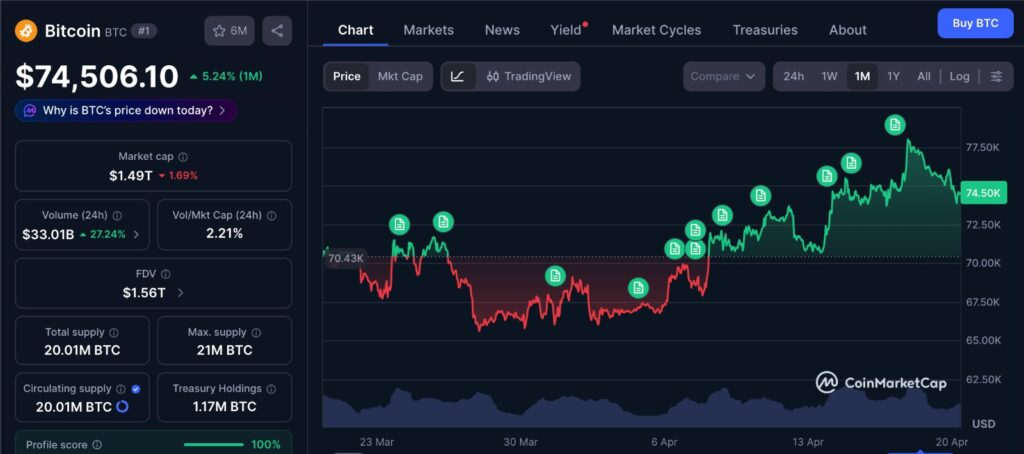
The one month Bitcoin price chart highlights how ETF driven demand does not align with immediate price expansion. Periods of consolidation often reflect active absorption, where liquidity providers offset incoming flow without allowing price to adjust. These phases compress imbalance beneath the surface, which later resolves when absorption capacity weakens and execution becomes more directional.
Editor’s View:
ETF flows are often interpreted as a direct signal of strength, but that assumes markets respond immediately to demand. In reality, institutional flow is designed to avoid visibility. It is distributed, hedged, and absorbed before it is ever expressed through price.
What appears inactive is often controlled execution.
The key transition occurs when that control breaks. Not because demand increases, but because the system can no longer process it efficiently. That is when price stops reflecting balance and starts reflecting pressure.
Conclusion
Bitcoin ETF flows are best understood as a measure of positioning rather than immediate impact. They indicate where capital is entering, but not how or when it will influence price. The market’s response depends on liquidity conditions, execution constraints, and the willingness of participants to absorb risk.
As long as absorption holds, demand remains hidden. When it fails, price becomes the mechanism through which imbalance is resolved.
The difference between those two states is where most of the market movement is created.
Suggested Links
Keep yourself updated with the latest crypto analysis with Blockbuzzed
Keep yourself updated with the latest news around Bitcoin with Blockbuzzed

