
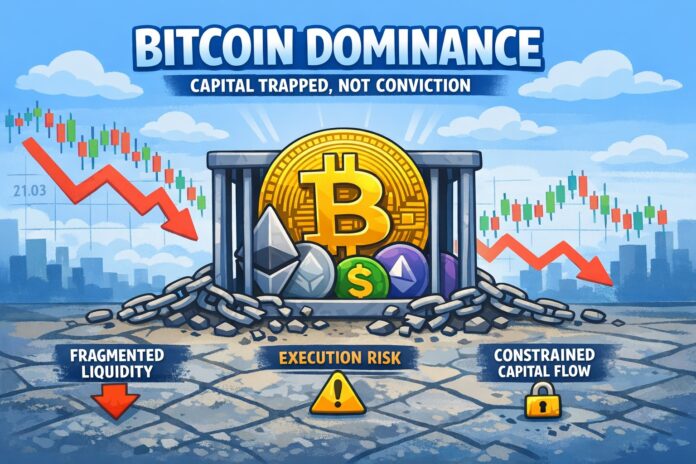
Bitcoin dominance trend rises not when capital becomes confident, but when it runs out of efficient alternatives. What looks like strength is often the result of constrained movement, a market where capital cannot rotate without increasing execution risk or distorting price. When liquidity fragments across altcoins, Bitcoin becomes less of a preferred asset and more of a functional base layer for capital. Over the past week, conditions have shown that even as price stabilizes, capital remains concentrated, suggesting that the constraint is not directional uncertainty, but limited mobility across the market.
What Bitcoin Dominance Actually Measures
At a basic level, Bitcoin dominance represents the proportion of total crypto market capitalization held in Bitcoin relative to the rest of the market. It is a relative metric, not an absolute one.
That distinction matters because dominance can increase even when:
- Bitcoin is not strongly trending upward
- Total market capital is declining
- Altcoins are simply losing value faster
But beneath this, dominance is not measuring strength, it is measuring where capital can remain stable under pressure.
Recent sessions have shown that during periods of reduced participation, capital does not exit uniformly. Instead, it compresses into assets where execution remains reliable. Bitcoin absorbs this compression not because it is outperforming, but because it can handle size without destabilizing price.
Price doesn’t move because demand increases – it moves because there’s no liquidity left to absorb that demand.
Dominance, in this sense, reflects the boundary of absorption. It reveals where liquidity is still capable of holding positioning without forcing displacement.
Capital Rotation Requires Liquidity, Not Just Interest
The idea that capital rotates into altcoins based on interest ignores the primary constraint that governs markets: execution.
Rotation requires:
- Depth that can absorb size
- Spreads that remain tight under pressure
- Confidence that exits will remain available
Without these conditions, interest becomes irrelevant. Capital does not move simply because opportunity exists, it moves when execution risk is low enough to justify participation.
This is where participant behavior diverges.
Retail participants can enter based on expectation. Larger participants cannot. Their decisions are shaped by how their size interacts with the order book, not just at entry, but at exit.
Over the past week, even as narratives around altcoins improved, order book conditions remained inconsistent. This mismatch between interest and execution explains why rotation often fails to materialize when expected.
Capital doesn’t chase opportunity, it avoids environments where exiting becomes uncertain.
This dynamic aligns with the structural patterns discussed in altcoin rotation signals, where rotation begins only after liquidity conditions become stable enough to support it.
Why Capital Gets “Trapped” in Bitcoin
Bitcoin functions as the most stable execution layer in a market where liquidity elsewhere is conditional.
Its advantages are structural:
- Deep, consistent order books across exchanges
- Tight spreads even during volatility
- High capacity to absorb directional flow
Altcoins, by contrast, operate in fragmented liquidity environments. Depth varies significantly, spreads widen quickly, and large orders can move price disproportionately.
For larger participants, this introduces execution risk, a form of risk that compounds with size. A position that cannot be exited efficiently behaves differently from one that can, regardless of its potential upside.
Current market conditions suggest that this gap in execution reliability is widening. Liquidity in altcoins has become more reactive, while Bitcoin continues to maintain stable depth.
Liquidity doesn’t disappear, it steps back when it expects to be tested.
This is why capital remains concentrated in Bitcoin. It is not safer directionally, but it is more predictable mechanically, a behavior closely tied to how bitcoin liquidity depth signals determine whether markets can absorb pressure without breaking structure.
This behavior connects directly with bitcoin liquidity depth signals, where the ability to absorb pressure determines whether price remains stable or begins to move.
Dominance Rises When Movement Becomes Difficult
Bitcoin dominance increases when movement across the broader market becomes harder to execute.
Recent sessions have shown that as volatility compresses, altcoin order books become less stable. Smaller flows begin to create larger price reactions, and execution becomes inconsistent across venues. Under these conditions, capital does not expand outward, it contracts inward.
This creates a repeatable sequence:
- Liquidity weakens across altcoins
- Order books become thinner and more reactive
- Execution risk rises with position size
- Capital consolidates into Bitcoin
Dominance rises as a result of this contraction, not because Bitcoin is gaining strength.
Capital doesn’t rotate because it sees opportunity, it rotates when execution stops being a constraint.
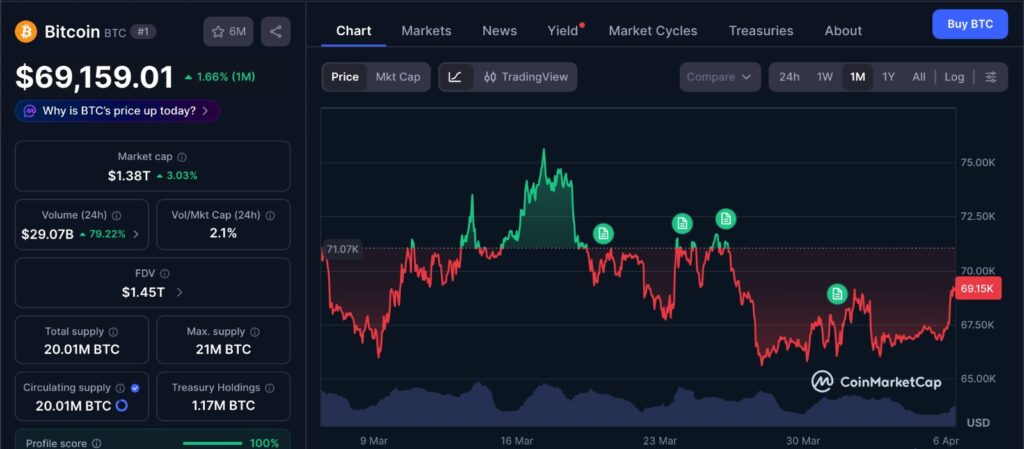
The 1-month Bitcoin dominance chart reflects this compression dynamic rather than directional strength. Periods where dominance trends upward tend to align with phases where altcoin liquidity becomes uneven and participation declines. Over the past month, similar conditions have shown that even when price remains stable, capital refrains from dispersing. This suggests that the constraint is not uncertainty about direction, but instability in how capital can move across assets.
Market Makers Reinforce This Containment
Beneath observable price action, market makers determine how much liquidity is actually accessible, not just how much appears on the surface.
In Bitcoin:
- Depth is continuously replenished
- Spreads remain tight across venues
- Liquidity remains resilient under stress
In altcoins:
- Liquidity is selectively provided
- Spreads widen rapidly under imbalance
- Depth can be withdrawn before pressure fully materializes
This behavior reflects forward-looking risk management. Market makers adjust their exposure based on expected flow, not just current conditions. When they anticipate imbalance, they reduce liquidity in assets where hedging becomes difficult.
This creates an important structural dynamic between derivatives and spot markets.
In derivatives, positioning can expand quickly because liquidity appears deeper. But when positions need to be closed, execution depends on underlying spot liquidity, which may not be able to absorb that size. This mismatch forces larger participants to prioritize assets where spot depth remains reliable.
Over the past week, this divergence has become more visible, with derivatives activity expanding while spot liquidity in altcoins remains inconsistent.
Larger participants do not size positions based on conviction, they size based on exit capacity.
This aligns with the mechanics explored in crypto market makers control timing, where liquidity availability determines when markets are able to move and when they remain constrained.
Editor’s View: Why Dominance Reflects Structural Limits, Not Conviction
Bitcoin dominance is often interpreted as belief in Bitcoin, but it more accurately reflects the limits of the surrounding market. When liquidity becomes unreliable elsewhere, capital is not choosing Bitcoin, it is defaulting to the only environment where execution remains functional. This creates the appearance of strength without requiring conviction. What looks like preference is often just constraint in disguise. Dominance, in that sense, reveals the boundaries of what the market can handle, not what it wants.
Conclusion
Bitcoin dominance trend is not a measure of strength, it is a measure of constraint. It reflects how much of the market remains accessible to capital without introducing execution risk.
When liquidity is stable and depth is sufficient, capital disperses. When liquidity fragments and execution becomes uncertain, capital compresses into assets that can sustain it.
Dominance does not indicate direction. It reveals where the market is still able to function without breaking.
Suggested Links
Keep yourself updated with the latest news around Altcoins with Blockbuzzed
Keep yourself updated with the latest news around Ethereum with Blockbuzzed
Keep yourself updated with the latest news around Bitcoin with Blockbuzzed

