

XRP whale inflows are exposing a difficult question about the cryptocurrency’s recovery: large holders are gaining greater flexibility to sell, but buyers have yet to demonstrate comparable demand at higher prices. A rebound can attract attention without attracting enough committed capital to sustain it. That distinction matters as XRP returns to a region where buyers previously defended prices. The real test is whether demand can absorb additional supply without relying on sellers to temporarily step aside.
XRP’s retreat from approximately $1.65 in September toward the $1.25–$1.30 region in October has brought this tension into focus.
Recent on-chain reports indicate that large holders have transferred substantial amounts of XRP to exchanges. Meanwhile, wallet creation has increased, and U.S. spot XRP exchange-traded funds have continued to attract some investment despite uneven flows.
Over the past week, XRP’s attempts to recover have struggled to hold, illustrating the difference between improving participation indicators and sustained buying demand.
The central question is not whether investors remain interested in XRP. It is at what price they are willing to absorb the tokens that existing holders may decide to sell.
XRP Whale Inflows Reveal Potential Selling Pressure
Exchange activity has become one of the more important signals surrounding XRP’s recent decline.
According to CryptoQuant analyst Darkfost, transfers involving more than one million XRP to Binance increased significantly over recent months.
The reported monthly-average dollar value of these qualifying whale inflows reached approximately $112.4 million, its highest reading since March 2026. That was roughly $72 million above the August reading and exceeded the approximately $90 million average recorded over the preceding three months.
Individual daily readings also surpassed $400 million.
These figures describe a dollar-denominated exchange-inflow measure, not the total amount deposited during an entire month or the value of completed sales.
The timing matters as much as the magnitude.
The increase followed a substantial recovery in XRP from its August levels, potentially improving the profitability of positions accumulated earlier.
For large holders, a rebound can create an opportunity to reduce portfolio concentration, realize profits, or rebalance exposure without necessarily abandoning a longer-term investment thesis.
A profitable investor does not need to become bearish before selling. Portfolio limits, liquidity requirements, and risk management can make reducing exposure rational even when the broader outlook remains constructive.
However, an important distinction remains.
An exchange deposit is not the same as a completed sale.
Tokens can move onto trading platforms for potential selling, collateral management, liquidity provision, portfolio rebalancing, operational transfers, or other trading and custody purposes.
The reported data establishes that substantial amounts of XRP moved toward Binance. It does not identify the intentions of individual wallet owners or establish how much was subsequently sold.
What changes immediately is the holder’s execution flexibility.
Moving XRP from external custody to a trading venue can reduce the operational delay between deciding to sell and placing an order. A large holder gains the ability to respond more quickly to changing market conditions without committing to a transaction.
That is the mechanism behind XRP’s recovery test: whale deposits increase the supply that could reach the market quickly, while the durability of a rebound depends on whether buyers can absorb it without demanding progressively lower prices.
The market does not need whales to start selling before their supply matters. It only needs buyers to recognize that more supply can reach them quickly.
This is an analytical risk rather than proof that buyers have already changed their behavior in response to the transfers.
Importantly, Darkfost’s reported inflow readings have since moderated toward more typical levels. That reduces the immediate significance of the earlier spike, although it does not establish what happened to tokens already deposited.
Why Exchange Liquidity Matters More Than Whale Activity Alone
Whale transactions attract attention because of their size, but transaction size alone does not determine market impact.
What matters is the liquidity available when those holdings are traded.
A large XRP holder can transfer millions of tokens to an exchange without immediately moving the market price. The eventual impact depends on available bid depth, execution speed, the trading venue, and the willingness of buyers to absorb supply.
Consider a large sale executed against a deep order book.
If substantial buy orders are distributed across nearby price levels, the transaction may be completed with limited price disruption.
The same sale executed rapidly on a venue with thinner bids could consume available liquidity and require progressively lower execution prices.
Volatility adds another complication. Orders visible before a large transaction may be canceled or repriced as market conditions change, making displayed liquidity different from what can actually be executed.
This is why identical selling volumes can produce very different price reactions.
Large holders determine how much supply might enter the market. The order book determines how expensive it becomes for everyone else to absorb it.
There is also a behavioral dimension.
When participants expect substantial selling, they may become less aggressive in placing bids. Liquidity providers may adjust quotations to manage the risk of accumulating inventory during unfavorable price movements.
If these adjustments occur together, selling can encounter less immediate buying interest even without a dramatic increase in transaction volume.
However, the reported XRP exchange transfers do not independently demonstrate that market makers have reduced bid depth or that buyers have withdrawn orders.
Those conclusions would require exchange-specific order-book observations and executed trade data.
The important distinction is that exchange inflows identify potential supply, while execution liquidity determines how disruptive actual selling becomes.
XRP’s $1.25 Support Zone Faces a More Difficult Test
XRP’s price structure adds another dimension to the exchange-flow discussion.
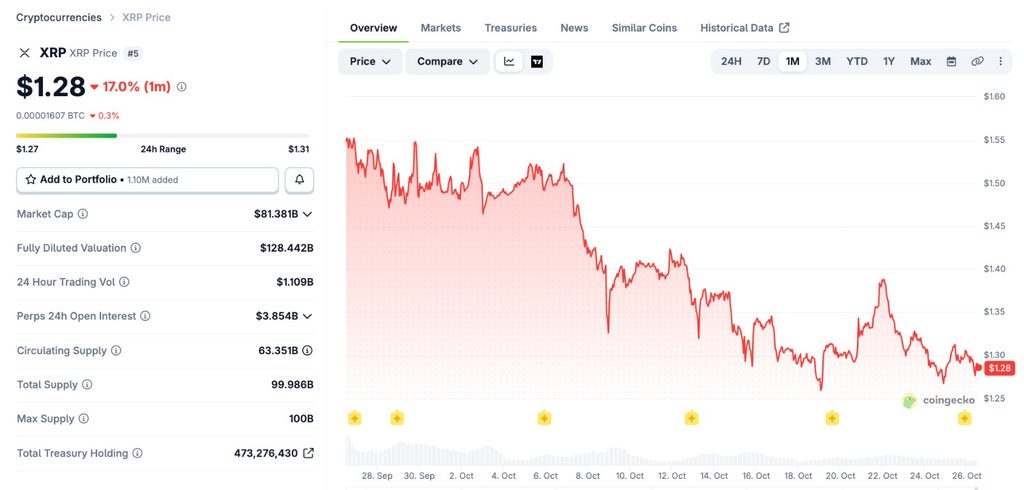
In mid-September, the cryptocurrency traded near $1.25 before recovering toward $1.65 later that month.
October’s decline brought XRP back toward the same general region. Historical price data showed the token near $1.29–$1.30 on October 24–25.
The return matters because investors encountering a familiar price level may no longer have the same financial position or expectations.
Support is often treated as a fixed technical boundary. In reality, it reflects the behavior of participants who previously considered that price attractive.
Some holders who accumulated near earlier lows may still be profitable. Others who purchased during the September recovery may now be carrying unrealized losses.
These groups face different incentives.
Profitable investors can reduce exposure while preserving gains. Buyers holding losses may use a rebound toward their acquisition costs to exit positions.
Both behaviors can create selling interest above support.
That helps explain why a second visit to the same price region may produce a different reaction from the first.
During the initial recovery, buyers may have competed for available XRP. On a subsequent rebound, some earlier buyers may become potential sellers.
The price level is familiar, but the composition of willing buyers and sellers may have changed.
For the current structure, three areas provide useful conditional reference points:
- $1.25: A historical buyer-response region tested during September and revisited in October.
- $1.30: A near-term stabilization area around which XRP has recently traded.
- $1.40: A potential recovery region where renewed selling could test the strength of demand.
These are reference levels based on recent price behavior, not guaranteed boundaries.
What Would Confirm Stronger Support?
A recovery from the $1.25–$1.30 region would become more convincing if buyers demonstrated an ability to absorb renewed selling without repeated sharp reversals.
Higher trading volume alone would not establish that demand had strengthened.
Every completed transaction involves a buyer and a seller. Volume does not independently reveal whether aggressive buyers are lifting offers or existing holders are finding sufficient counterparties to reduce exposure.
The more informative behavior would be XRP holding higher prices after encountering meaningful supply.
A rebound can develop simply because selling intensity has declined. That does not necessarily mean new buyers are willing to support progressively higher valuations. A similar distinction between temporary price stabilization and sustained buying demand has also been evident in Bitcoin’s recent recovery attempts.
A support level is not proven when price bounces from it. Its strength becomes clearer when sellers return and fail to push price back down.
For XRP, sustained trading above the recent support area, improving spot demand, and more stable exchange flows would provide stronger evidence than an isolated upward move.
The 1-month XRP chart helps illustrate how the token retreated toward the $1.25–$1.30 area after trading at higher levels during September. The important question is whether buyers can defend this region while large holders retain access to exchange liquidity. A sustained recovery toward $1.40 would suggest improving demand, while repeated reversals would indicate that available selling pressure remains difficult to absorb.
Rising XRP Wallet Activity Does Not Automatically Mean Stronger Demand
While exchange flows have raised concerns, XRP Ledger activity has presented a more constructive signal.
According to Santiment’s October 22 observations, the number of non-empty XRP Ledger wallets reached approximately 8.24 million.
The analytics firm also reported 4,772 new wallets created in a single day, the fifth-largest daily increase recorded since March.
These figures suggest expanding address participation despite XRP’s recent price weakness.
However, address growth and investment demand are different measurements.
A single investor can control multiple addresses, while exchanges and other services may create wallets for operational purposes.
New addresses therefore do not necessarily represent new investors or fresh capital entering the market.
Even when additional wallets reflect genuine participation, their price impact depends on the amount of XRP being accumulated.
Thousands of smaller accounts could collectively represent less buying power than a relatively small group of large holders preparing to reduce exposure.
Network participation can broaden without buying power increasing proportionally.
There is also a difference between opening a position and maintaining it.
Wallet creation captures activity at a particular moment. A sustained recovery depends on whether investors continue holding or acquiring XRP as prices increase.
Wallet growth becomes more informative when accompanied by increasing balances, persistent accumulation, and evidence of actual buying activity.
For XRP, the reported expansion in addresses demonstrates continued network interest. It does not establish how much demand is available to absorb potential selling at higher prices.
Why XRP ETF Inflows Have Not Prevented the Decline
Institutional investment products provide another example of why constructive indicators can coexist with weak price performance.
According to SoSoValue data cited in October 23 market reporting, U.S. spot XRP ETFs attracted approximately $4.25 million in net inflows during the trading week through October 22, following approximately $1.84 million in net outflows the preceding week.
The earlier weekly outflows had interrupted a reported 13-week inflow streak.
These figures refer to reported flows into the U.S. spot XRP ETF category, rather than all global XRP investment products. They also describe separate trading weeks, not cumulative inflows for the entire month.
The change in direction is relevant, but the scale of inflows must be considered alongside activity elsewhere in the market.
ETF investors may be increasing exposure while existing XRP holders reduce positions through exchanges or other trading arrangements. This difference between institutional investment flows and actual price support is also relevant to Bitcoin and Ethereum, where ETF activity does not always translate directly into stronger market performance.
These decisions can occur simultaneously without producing higher prices.
The relationship is also affected by how individual funds obtain underlying exposure. Depending on their creation and redemption arrangements, reported ETF inflows do not necessarily translate into identical amounts of immediate buying on public spot exchanges.
There is a further difference in investor behavior.
An institutional allocator may acquire XRP gradually to meet portfolio exposure targets. A large holder who accumulated tokens at lower prices may use improving liquidity to reduce concentration.
Both decisions can be rational, even when they generate opposing market flows.
Their impact also depends on price sensitivity.
Longer-term allocators may follow a scheduled allocation process, while existing holders may become more willing to sell as XRP approaches particular profit or break-even levels.
Consequently, demand can remain present while the supply offered at higher prices increases.
Institutional participation can broaden the investor base without immediately overwhelming existing selling interest.
The October flow figures therefore indicate continued investment activity, but they do not independently establish that XRP has entered a sustained accumulation phase.
Reduced Whale Withdrawals Add Another Layer of Uncertainty
Exchange inflows represent only one side of the large-holder picture.
Separate CryptoQuant-based analysis reported on October 20 showed that the 90-day moving average of the dollar value of large XRP withdrawals from Binance had fallen toward approximately $49.7 million.
The reading was reported as the lowest since October 2021, approximately five years earlier.
Exchange withdrawals are sometimes associated with investors moving tokens into external custody, potentially reducing the amount readily available for trading.
However, lower withdrawals do not prove that large holders have stopped accumulating. Transfers may occur for operational reasons, and investors can maintain or increase exposure while keeping assets on exchanges.
The comparison with rising whale inflows also requires care.
The $112.4 million inflow reading and $49.7 million withdrawal reading track different directions of exchange movement and use different observation windows and smoothing methods.
Both are dollar-denominated measures, which introduces an additional limitation.
Lower dollar-denominated withdrawals do not necessarily mean the same proportional decline in the number of XRP tokens being moved.
Changes in XRP’s market price can affect the reported dollar value even when token-denominated transfer activity changes less substantially.
The figures therefore cannot be subtracted to calculate net whale selling.
Their combined significance is more limited but still useful: Binance experienced elevated large-holder inflow readings while a separately measured indicator of large withdrawals remained historically subdued.
That raises questions about large-holder positioning without establishing whether the affected wallets were accumulating, selling, or transferring assets for other purposes.
A more complete assessment would require exchange reserves, token-denominated inflows and withdrawals, wallet balance changes, and executed market activity.
Until those measures are considered together, the reported movements are evidence of changing exchange flows rather than definitive proof of a directional shift in whale holdings.
Market Makers Could Influence the Timing of XRP’s Recovery
Large holders face a different execution problem from most retail traders.
A relatively small investor can often enter or exit a position without materially affecting available liquidity. Institutions managing much larger exposures must consider how their own transactions could change execution prices.
Selling an entire position aggressively can consume bids and increase slippage. As a result, larger participants may distribute orders gradually or across several venues to manage market impact.
That execution process can influence price behavior without producing one obvious large sale.
Market makers introduce another layer.
When selling becomes concentrated, liquidity providers may accumulate inventory while facilitating transactions. To limit additional exposure, they can reduce bid sizes, widen spreads, or adjust quotations.
These actions reflect inventory and execution risk rather than necessarily expressing a bearish fundamental view of XRP.
Derivatives markets can also affect how large participants manage exposure.
An investor may hedge directional risk through derivatives instead of immediately selling an entire spot position. Counterparties to those hedges may subsequently adjust their own positions through spot markets or other derivatives.
Trading pressure can therefore pass through several instruments before affecting the underlying market.
This does not establish that such hedging activity is currently driving XRP’s price.
The available exchange-flow figures do not identify individual execution strategies or demonstrate coordinated market-maker activity.
What they establish is the relevance of execution conditions: the effect of large-holder supply depends not only on the amount traded, but also on how liquidity providers and counterparties respond while orders are being filled.
What Could Change XRP’s Recovery Outlook?
Three market developments would help distinguish an improvement in underlying demand from temporary relief in selling activity.
Scenario 1: Whale Deposits Continue to Normalize
Darkfost’s reported Binance whale inflows have already moderated from earlier elevated readings.
If lower deposits coincide with stronger spot buying, the market could face less immediate pressure from newly exchange-accessible supply.
However, previously deposited XRP may remain available for trading.
The more meaningful evidence would be sustained price support while buyers absorb existing exchange supply, rather than higher prices resulting solely from reduced selling activity.
Scenario 2: Selling Pressure Returns Near Resistance
A rebound toward approximately $1.40 could bring XRP back into a region where existing holders become more willing to reduce exposure.
Investors who purchased during earlier recovery attempts may use improving prices to exit near their acquisition costs. Profitable holders may also sell to protect gains.
If XRP repeatedly reverses from that region, it would suggest buyers remain unwilling or unable to absorb the available supply at those valuations.
Sustained trading near or above the area despite renewed selling would provide stronger evidence of improving demand.
Scenario 3: The $1.25 Region Fails to Hold
A sustained move below the historical $1.25 buyer-response zone would indicate that previous demand had become insufficient relative to available supply.
Such a move could influence short-term positioning and increase pressure on leveraged traders.
Forced liquidations could amplify volatility if substantial leveraged exposure were concentrated around affected price levels. However, the available reporting does not establish that concentration.
The significance of a breakdown would therefore be behavioral rather than predictive: a region that previously attracted buyers would no longer be producing the same degree of support.
It would not establish a guaranteed downside target.
The Bigger Question for XRP Is Who Absorbs the Supply
XRP’s recent indicators describe different parts of the market.
Whale transfers show that substantial amounts of XRP have moved toward trading venues. Wallet growth indicates broader address participation, while ETF flows show that some institutional investment demand remains present.
None of these measures independently establishes the balance between active buyers and sellers.
Participation, capital allocation, and executable liquidity are not interchangeable.
The distinction matters because XRP can attract new interest without attracting sufficient buying capital at the prices where existing holders want to exit.
The sustainability of a recovery depends on that relationship, not simply on whether individual indicators appear constructive.
Editor’s View: XRP’s Recovery Is a Test of Conviction, Not Attention
The most revealing aspect of XRP’s current market structure is that positive participation indicators have appeared alongside continued difficulty sustaining higher prices.
This suggests the immediate constraint may not be a complete absence of buyers. It may be that buyers remain willing to accumulate near $1.25–$1.30, while existing holders become more willing to release supply as prices approach $1.40.
Both groups can remain active without creating a lasting recovery.
That distinction changes how whale inflows should be interpreted. The transfers themselves do not prove selling, but they increase the relevance of buyer willingness and execution liquidity when large holders decide to transact.
A stronger recovery would become visible through XRP’s ability to hold higher prices despite renewed selling, rather than simply through a reduction in exchange deposits or an increase in wallet creation.
The central issue is whether demand can remain firm as prices rise and existing holders gain opportunities to exit.
A market is not strong because sellers are absent. It is strong when sellers are present and buyers no longer need a discount to absorb them.

