
RWA Tokenization refers to converting real-world assets—like real estate, art, bonds, or commodities—into digital tokens on a blockchain. This process enables fractional ownership, global trading, and smart-contract automation, unlocking liquidity and accessibility for traditionally illiquid markets.
1. Why Tokenize RWA?
Enhanced Liquidity & Fractional Ownership
Illiquid assets such as real estate or collectibles can be split into smaller tokens, allowing more people to invest and trade without owning the entire asset.
24/7 Trading & Cost Efficiency
Blockchain tokenization allows asset trading round-the-clock with near-instant settlement and reduced middlemen, lowering fees and friction.
Transparency & Global Access
All transactions are permanently recorded and transparent, opening global markets to both investors and issuers.
2. How RWA Tokenization Works
- Identify & Appraise Asset: Valued and legally structured, often via a Special Purpose Vehicle (SPV) or trust.
- Legal Wrapper: SPVs hold legal rights to back tokens sold; ensures compliance.
- Token Creation: Asset is represented on blockchain as fungible or non-fungible tokens.
- Smart Contracts: Automate rules like transfers, payouts, and compliance.
- Trading & Management: Tokens are fluidly traded or held, with blockchain-based reporting enabling compliance.
3. RWA Use Cases
- Real Estate:
Luxury resorts and property developers have issued fractionalized ownership via tokenized real estate deals. - Art & Collectibles:
High-value artwork has been tokenized, allowing collectors to buy fractions of rare pieces. - Commodities & Gold:
Gold-backed tokens let users hold digital assets tied to physical gold stored in vaults. - Financial Instruments & Bonds:
Major financial institutions have piloted tokenized bond offerings and money market funds. - IP, Carbon Credits, Infrastructure:
Tokenization is expanding to patents, carbon credits, and large infrastructure projects.
4. Benefits vs. Challenges
| Benefits | Challenges |
|---|---|
| Improved liquidity | Regulatory uncertainty across jurisdictions |
| Fractional & global investment | Ensuring accurate legal and asset ownership |
| 24/7 smart-contract execution | Security, scalability, and tech limitations |
| Cost savings via automation | Market fragmentation and interoperability risks |
5. The Road Ahead for RWA Tokenization
- Mass adoption:
Institutional players are driving mainstream tokenization via regulated platforms. - DeFi and Interoperability:
Tokenized assets are entering DeFi ecosystems, offering yield-bearing instruments through on-chain integration. - Regulatory maturation:
Legal frameworks are emerging globally, with sandbox regimes and compliant issuance tools enabling more growth.
6. Key Players and Platforms Driving RWA Tokenization
The tokenization of real-world assets is being spearheaded by both traditional financial institutions and crypto-native platforms. Companies like BlackRock, Franklin Templeton, and JPMorgan are actively piloting tokenized funds and securities on blockchain networks such as Ethereum and Polygon. For example, BlackRock recently launched a tokenized U.S. Treasury fund, opening up on-chain access to a $30 trillion market traditionally dominated by institutions.
Meanwhile, DeFi-native protocols like Ondo Finance, Centrifuge, Maple Finance, and MakerDAO are leading in integrating tokenized RWAs into decentralized lending, yield strategies, and liquidity pools. These platforms allow RWA tokens to be used as collateral, enabling passive income generation through real-world cash flows such as rental income or loan repayments.
Additionally, custodians like Fireblocks and Anchorage Digital offer institutional-grade infrastructure to secure RWA tokens, ensuring compliance with evolving financial regulations. These tools are critical in attracting hedge funds, asset managers, and government-backed issuers to the ecosystem.
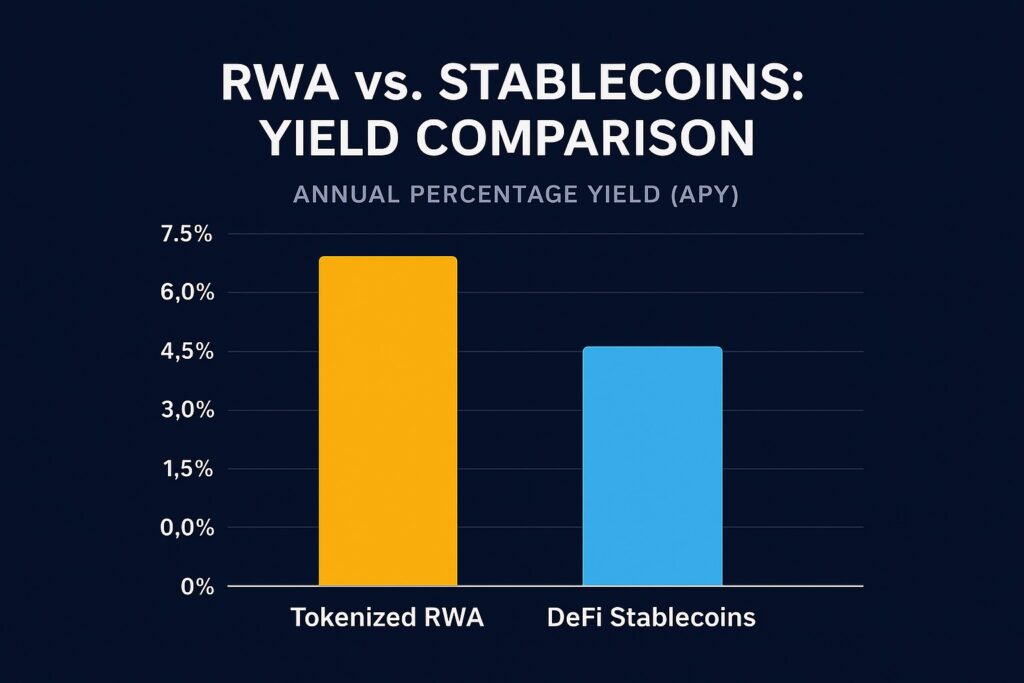
The chart below compares average yield rates of popular tokenized RWAs with leading DeFi stablecoin platforms, showcasing how on-chain real-world assets are becoming lucrative alternatives for yield-seeking investors.
7. Industry Momentum and Market Size Outlook
According to research by Boston Consulting Group, the market for tokenized RWAs could grow to as much as $16 trillion by 2030. Tokenized financial instruments, including treasuries, private equity, and real estate, could represent a significant chunk of global capital markets within the next 5–10 years. (Source: Coindesk)
This momentum is fueled by rising interest from both retail and institutional investors seeking transparency, 24/7 access, and exposure to real assets without traditional constraints. Governments are also exploring tokenized public bonds and infrastructure funding models via blockchain.
Tokenization could become a defining pillar of the next generation of finance, merging the trust of real-world assets with the speed, accessibility, and programmability of blockchain.
Final Take
RWA Tokenization is unlocking a new frontier for asset ownership—turning illiquid assets into fractional, digitally-native tokens. While still early, it promises greater liquidity, efficiency, transparency, and access. As institutional adoption grows and regulations solidify, this technology could democratize access to high-value assets, reshape finance, and transform markets into inclusive global ecosystems.
Suggested Links
Keep yourself updated with the latest in Blockchain with Blockbuzzed

