

Bitcoin liquidity depth is quietly reshaping how price reacts
Bitcoin liquidity depth is often discussed as if it were just another market metric, but it is really a measure of how much conviction is willing to sit close to the current price. When depth thins while Bitcoin remains range-bound, the market is not proving balance. It is showing that participants are less willing to defend levels with real size. That distinction matters because price does not need aggressive demand to move meaningfully in this kind of environment – it only needs less opposition than before. In thin conditions, stability is often just delayed movement.
What liquidity depth actually measures beneath the surface
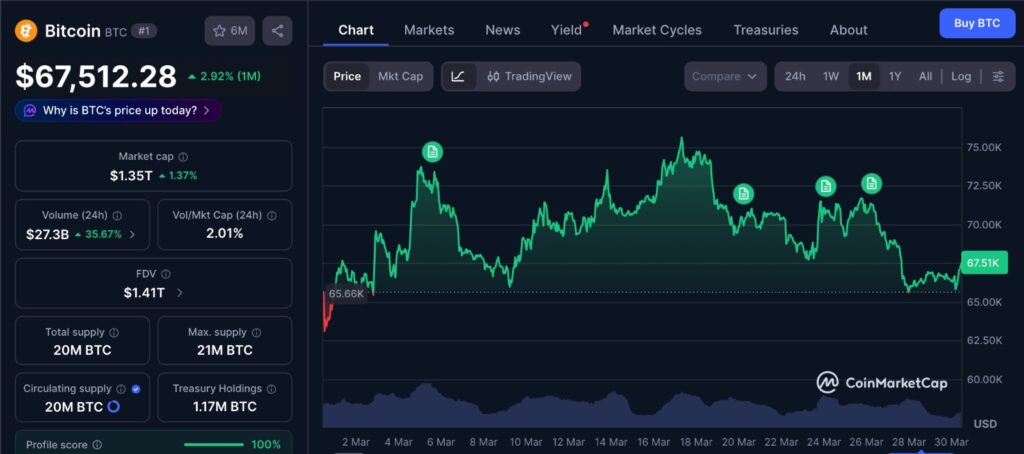
The chart above shows Bitcoin’s price behavior over the past month, where movement has remained relatively contained even as market conditions suggest reduced liquidity depth across exchanges. That kind of compression can look constructive on the surface, but it often reflects a narrower band of active participation. The market looks calm not because it is firmly supported, but because fewer participants are willing to challenge price in either direction.
Liquidity depth is not simply the number of bids and asks on a screen. It reflects how much real executable interest is prepared to absorb flow without forcing price to search for the next level. When that depth pulls back, the order book stops functioning like a cushion and starts functioning like a gap map, a dynamic that becomes even more pronounced when supply itself is structurally removed from circulation, as seen in Ethereum’s staking-driven supply compression.
Price does not move because everyone suddenly agrees on a new value; it moves because the market runs out of nearby inventory, a condition where even small imbalances can drive disproportionate movement, as explored in bitcoin order book imbalance.
This matters for three reasons:
- Small flows begin to carry larger price impact
- Visible stability starts to depend on inactivity
- Short-term price discovery becomes less trustworthy
The deeper point is behavioral. When participants pull orders away from the market, they are not always turning bearish or bullish. Often they are protecting themselves from adverse selection – the risk of being the resting liquidity that gets hit just before price moves further against them. That is especially true for larger players and market makers, who care less about being early than about not getting trapped. A thin book is often a sign that professional liquidity providers no longer view current conditions as attractive for passive exposure.
Why stable price doesn’t mean strong market conditions
Sideways price is often mistaken for equilibrium. In reality, it can also be the signature of a market where conviction has stepped back and only noise remains active. A flat range tells you very little on its own, especially when capital is not actively rotating but instead remaining parked, a behavior often reflected in Bitcoin dominance trends where capital becomes constrained rather than confident. What matters is whether that range is being actively defended or merely left undisturbed.
In thinner conditions, price can stay stable simply because neither side is willing to show size. Retail traders often read that as evidence of accumulation, distribution, or quiet confidence. Larger participants read it differently. They know that when order books are shallow, the market is not absorbing information smoothly; it is postponing resolution until a larger flow forces it.
This creates a structural illusion:
- Low volatility gets mistaken for strength
- A narrow range gets mistaken for control
- Quiet trading gets mistaken for agreement
But a quiet market is not always a healthy market. Sometimes it is just a market with less standing in front of it. Price does not always break out because pressure builds. Sometimes it breaks because support was never as real as it looked.
How thinning liquidity changes trader behavior
As liquidity depth declines, execution becomes more important than direction. For large participants, the challenge is no longer just being right about the market. It is entering and exiting without revealing intent or moving price against themselves. That changes behavior immediately.
Instead of placing obvious size in spot, larger traders often split orders, widen execution windows, or shift risk into derivatives where liquidity appears deeper and entry is easier to disguise – reinforcing the idea that markets are not just driven by demand, but by how and when liquidity is allowed to be accessed. Retail typically experiences the market through price candles. Institutions experience it through slippage, queue position, and how much size can be transferred before the market reacts. That difference matters because it changes who is actually shaping price in quiet periods.
The result is a more distorted market structure:
- Spot becomes less informative as a source of genuine demand
- Derivatives absorb more activity and begin steering short-term moves
- Liquidations and positioning adjustments matter more than outright buying or selling
This is where execution risk becomes structural. Market makers and larger participants do not simply withdraw because they are uncertain; they withdraw because the cost of being wrong rises sharply when depth is thin. In those conditions, passive liquidity becomes expensive. If a market maker cannot hedge efficiently or suspects one-sided informed flow, quoted size shrinks and spreads widen. That reduction in visible liquidity makes the market look tradable from a distance but harder to move through cleanly in size. Retail sees a chart. Professional participants see a transfer problem.
Editor’s View: Liquidity reveals where conviction ends
Most traders look at price first and treat liquidity as supporting detail. In practice, liquidity often tells the more honest story. Price can stay composed for long periods because it is the visible result of the last transaction, while liquidity exposes the willingness of participants to stand in front of the next one. When that willingness fades, the market becomes less of an auction and more of a vacancy. What looks like stability is often just an absence of confrontation. The important question is no longer where Bitcoin is trading, but how much real interest is still willing to trade there.
What this means for market structure going forward
Declining liquidity depth changes the character of price action before it changes the headline trend. The market becomes less continuous and more episodic. Instead of steady repricing, it shifts in bursts as pockets of thin liquidity give way. That makes moves look sudden even when the underlying cause has been building for days.
Several structural effects follow:
- Price reacts faster because there is less nearby inventory to absorb flow
- Support and resistance become less reliable because fewer participants are committed to defending them
- Positioning starts to matter more than narrative because the market is being driven by who must act, not who wants to act, a behavior that becomes more visible during capital rotation phases where liquidity shifts unevenly across assets.
This is why thin markets often produce exaggerated moves without a proportionate news catalyst. The catalyst is sometimes secondary. The real driver is that the market had already lost the ability to absorb imbalance smoothly. When spot depth weakens and derivatives carry more of the activity, price discovery becomes increasingly reflexive. Moves create more moves. What begins as a modest imbalance can become a sharper repricing because the market structure underneath it is less capable of slowing it down.
Conclusion
Bitcoin liquidity depth is not just background context for price action. It helps explain why price can look controlled while the market beneath it becomes easier to disrupt. Current conditions point to a structure where visible calm may say less about strength than about reduced willingness to participate near the tape. That is the key distinction. A market with deep conviction absorbs pressure. A market with thin depth often hides it until the moment it can no longer do so. Understanding that difference makes Bitcoin’s recent stability look less reassuring and far more conditional.
Suggested Links
Keep yourself updated with the latest crypto analysis with Blockbuzzed
Keep yourself updated with the latest news around Bitcoin with Blockbuzzed

