

AAVE price below $150 reveals a disconnect that institutional optimism alone cannot resolve. Citi Research’s favorable assessment of Aave’s role in tokenized finance has strengthened the protocol’s long-term narrative, yet its native token has struggled to sustain buying interest. The divergence raises a more important question than whether traditional finance will adopt decentralized lending: how much of that adoption can translate into economic value for AAVE holders? The answer depends on three separate developments: infrastructure adoption, sustainable protocol revenue and the mechanisms connecting that revenue to the token.
AAVE reportedly traded near $148 on October 21, extending its retreat from the $187 region reached roughly two weeks earlier.
Meanwhile, Aave’s lending activity has recovered from an earlier contraction. Active loans reached approximately $12.3 billion on October 20, according to DeFiLlama, although borrowing remained below previous highs.
Over the past two weeks, the contrast between the protocol’s recovering activity and its token’s weaker price performance has become more apparent.
That divergence does not necessarily mean investors are overlooking Aave’s progress. It may reflect uncertainty over how much of the protocol’s future economic growth can justify the token’s current valuation.
Adoption establishes whether users need the infrastructure. Revenue shows whether that usage generates economic returns. Token value capture determines whether those returns create meaningful benefits for AAVE holders.
Aave’s recent performance exposes why those outcomes cannot be treated as interchangeable.
Citi Research Sees a Larger Role for Aave in Tokenized Finance
Citi Research’s recent assessment highlights Aave’s potential role in improving how financial institutions use tokenized assets as collateral.
The opportunity centers on collateral mobility, allowing financial assets to support borrowing without requiring their owners to sell the underlying holdings.
In traditional markets, obtaining financing against securities can involve intermediaries, settlement procedures and collateral management arrangements that increase costs and operational complexity.
Tokenized assets could make parts of that process more programmable. The broader concept of real-world asset tokenization allows traditional financial assets to be represented through blockchain-based tokens, potentially making them easier to transfer and use as collateral.
An institution holding an eligible tokenized Treasury fund, for example, could potentially deposit those holdings into an approved lending market and borrow stablecoins against them.
The institution retains exposure to the underlying investment while obtaining liquidity, subject to collateral requirements, financing costs and liquidation risks.
Aave is already developing infrastructure for this activity.
Its Horizon market, launched in August 2025, enables institutions and other qualified participants to borrow stablecoins against eligible tokenized real-world assets.
Separately, Aave V4, which launched on Ethereum mainnet in March 2026 and expanded to Avalanche in July, introduced a Hub and Spoke architecture.
The architecture allows liquidity to be shared through designated hubs while connected lending markets maintain their own collateral configurations and risk parameters.
This potentially improves capital efficiency without requiring every asset or borrower to operate under identical lending conditions.
However, the economic opportunity extends beyond placing traditional assets on blockchain networks.
An institution holding tokenized securities gains limited financing benefits if borrowing against them remains expensive, operationally unreliable or difficult to manage during market stress.
Professional borrowers compare financing costs, collateral requirements, available liquidity and operational reliability against other sources of credit.
Institutions do not borrow because collateral has moved on-chain. They borrow when the financing terms and available liquidity make that capital more useful than competing alternatives.
Tokenization creates the asset’s digital representation. Financing determines whether that representation becomes economically productive.
For Aave, recurring borrowing against eligible collateral could become more valuable than attracting large deposits that remain largely unused.
But gaining a role in institutional financing requires more than technical capability. Institutions must be comfortable with settlement reliability, collateral enforcement, custody arrangements and how lending markets behave when asset values deteriorate.
Citi’s assessment supports the strategic relevance of this infrastructure. It does not establish the scale or profitability of future institutional adoption.
Aave’s $12 Billion Lending Recovery Shows Progress, but Not a Full Rebound
While AAVE’s token price has weakened, activity within the underlying protocol presents a more balanced picture.
According to DeFiLlama, Aave recorded approximately $12.3 billion in active loans on October 20, recovering from a contraction toward $9 billion earlier in the year.
Borrowing nevertheless remained below the roughly $18 billion reported during the earlier period of stronger lending activity.
Aave’s total value locked stood at approximately $17.9 billion on October 20, demonstrating the protocol’s continued scale within decentralized lending.
The recovery is meaningful, but the relationship between deposits and borrowing offers a clearer measure of economic activity.
When deposits increase faster than loans, a lending protocol gains available liquidity without necessarily generating equivalent financing demand.
Depositors may be seeking yields or maintaining collateral positions, while borrowers remain cautious about leverage, financing costs or market volatility.
For larger borrowers, the decision is particularly sensitive to whether expected returns justify interest expenses, collateral requirements and the risk of forced liquidation.
Liquidity available for borrowing measures capacity. Liquidity actually borrowed reveals whether participants see enough value in financing to accept its costs and risks.
The composition of borrowing matters as well.
Speculative leverage can expand rapidly during favorable market conditions, but it may contract when collateral prices fall or financing becomes expensive.
Recurring borrowing against tokenized financial assets could provide a different source of demand if institutions use the infrastructure consistently.
That does not automatically make institutional loans safer. Collateral quality, liquidity and the ability to manage liquidations remain essential.
Dollar-denominated lending growth also requires careful interpretation.
Changes in asset prices can affect the reported value of outstanding loans without reflecting an equivalent increase in borrowers or new financing activity.
The stronger evidence of recovery would therefore come from sustained loan demand, healthy utilization and improving revenue rather than larger deposits alone.
Recent sessions have shown that Aave’s recovering lending activity has not been sufficient to produce a comparable improvement in AAVE’s price.
That suggests the market is evaluating more than the protocol’s operational scale.
Why Growing Aave Adoption Is Not Automatically Bullish for AAVE
The relationship between Aave’s lending activity and its native token becomes clearer when examining how the protocol generates economic value.
Aave allows users to supply assets and borrow against eligible collateral. Borrowers pay interest, most of which compensates liquidity suppliers rather than becoming revenue available to the protocol.
The protocol captures economic value through mechanisms including reserve-factor allocations from lending interest and applicable fees associated with activities such as liquidations.
The distinction is important because total borrowing interest should not be confused with revenue available to the Aave DAO.
An institution borrowing stablecoins against tokenized securities may increase lending utilization and contribute to protocol revenue without purchasing AAVE directly.
However, Aave has established mechanisms intended to connect part of its economic activity to the token.
The Aave DAO introduced a governance-approved secondary-market AAVE buyback program in April 2025.
According to Aave governance disclosures published in February 2026, the program had acquired more than 205,000 AAVE over approximately ten months, with around $42 million allocated to purchases.
Those acquisitions demonstrate that protocol-generated resources can be directed toward actual token demand rather than relying exclusively on expectations of future adoption.
Importantly, purchased AAVE is held within the DAO’s ecosystem reserves and can support governance-approved activities, including ecosystem incentives and other expenditures. The program is not equivalent to permanently burning tokens or distributing cash directly to every holder.
Its economic impact also depends on execution and treasury conditions.
In March 2026, a governance proposal recommended reducing the annual buyback budget from approximately $50 million to $30 million as borrowing-fee revenue weakened and operational funding requirements increased.
The distinction between an established mechanism and its continuing execution became especially relevant in April.
Following an incident involving bridged rsETH collateral, Aave’s treasury service provider disclosed that buyback transactions had been paused from April 19 while potential losses and treasury obligations were assessed.
The available governance records establish the earlier purchases and subsequent suspension, but do not provide sufficient confirmation of a later resumption as of October 21.
That history reveals an important constraint.
Buybacks can provide a direct route from protocol economics to token demand, but their scale and continuity depend on treasury resources, governance decisions and competing financial obligations.
The DAO may need to preserve capital for security responses, operations or liquidity support rather than allocate it to token purchases.
Revenue quality also matters.
Aave’s February 2026 treasury analysis highlighted how liquidation-related revenue can rise temporarily during market disruptions, while more recurring borrowing-fee income may weaken.
Treating those temporary revenues as permanent funding capacity would overstate the resources available for sustained token purchases.
The decisive measure is therefore not simply whether Aave generates fees or has a buyback framework.
It is how much recurring economic value can be directed toward AAVE, how consistently that connection operates and whether the resulting demand is meaningful relative to selling pressure.
The protocol can win the customer while the token fails to win the investor.
Aave’s buyback history shows that a mechanism for connecting protocol activity to token demand exists. Its suspension also demonstrates why investors cannot treat that demand as an unconditional consequence of lending growth.
The Tokenization Opportunity Is Large, but Its Addressable Market Remains Uncertain
Aave founder Stani Kulechov has described the potential expansion of stocks and other financial assets onto blockchain networks as an opportunity exceeding $200 trillion.
The figure illustrates the enormous scale of traditional financial markets that tokenized infrastructure could potentially serve.
It does not represent a forecast of Aave deposits, borrowing volumes or revenue.
The total value of potentially tokenizable financial assets is not equivalent to Aave’s addressable lending revenue.
Several economic conditions separate those figures.
Assets must first become available in legally and operationally suitable tokenized forms. Their owners must then have a reason to borrow, while competing lending providers must offer financing terms that make Aave attractive.
Only the financing activity Aave actually captures can contribute to its lending economics.
Even then, borrowers’ interest payments do not flow entirely to the protocol, and protocol revenue does not translate automatically into token-related economic benefits.
This creates a narrower but more realistic way to evaluate the opportunity.
An institution may tokenize securities for settlement efficiency or custody without ever borrowing against them.
Another may require financing but obtain better terms through an existing bank or institutional credit provider.
Competition introduces another constraint.
As more platforms offer financing against similar collateral, borrowers may benefit from lower interest rates and greater choice.
That can increase borrowing activity while reducing the revenue earned per dollar lent.
Aave’s established liquidity and lending infrastructure may provide a competitive advantage, particularly where borrowers value reliable execution and capital availability.
However, its long-term economic position will depend on how effectively it converts that infrastructure into recurring, profitable lending activity.
The relevant opportunity is not the entire value of assets moving on-chain. It is the portion that generates financing demand Aave can serve at sustainable economics.
AAVE Price Below $150 Highlights Weak Short-Term Conviction
Against this longer-term opportunity, AAVE’s recent price performance presents a more immediate challenge.
The token reportedly encountered selling pressure around $187 before declining toward $148 on October 21.
The move briefly carried AAVE below the $150 region, which remains a useful short-term market reference rather than a guaranteed support or resistance level.
A sustained recovery above that area would suggest some improvement in buying demand, although broader confirmation would require stronger price behavior.
The $140 and $134 regions remain conditional downside reference points identified in recent market commentary, rather than independently established targets.
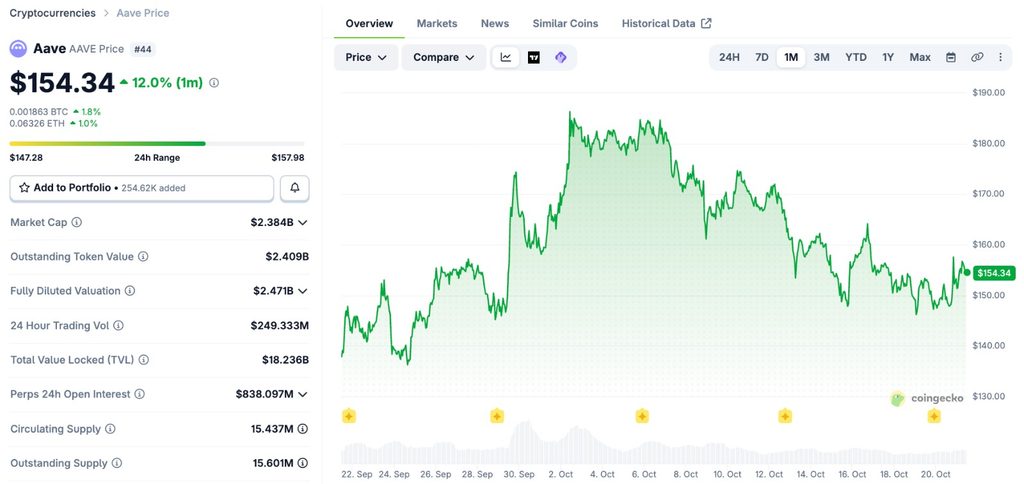
The one-month AAVE price chart provides context for the token’s reported retreat from around $187 toward $148, contrasting with the recovery in lending activity within the underlying protocol. The important question is whether buyers can absorb available supply around the $150 region or whether recoveries continue to fade. A stronger price response would indicate improving market demand, while persistent weakness would suggest that favorable institutional developments have yet to attract sufficient buying interest.
Positive fundamental developments cannot support price unless buyers are willing to absorb the supply being offered in the market.
For larger participants, that decision is shaped partly by execution conditions.
A substantial purchase can move the market against the buyer when order-book liquidity is limited. This illustrates why market liquidity depth matters to larger participants, as insufficient resting orders can increase execution costs even when their fundamental outlook remains favorable. Professional traders may therefore divide orders over time or avoid increasing exposure until transaction costs and volatility become more manageable.
Conversely, selling pressure can produce sharper price declines when available bids are thin. This is a broader feature of order-book imbalances, where the distribution of available buy and sell orders can amplify price movements even without an equivalent change in trading volume.
These mechanisms help explain why favorable research does not necessarily generate an immediate price recovery, although there is no verified evidence that changes in market-maker activity caused AAVE’s latest decline.
Derivatives positioning introduces another consideration.
A temporary rebound can develop when short sellers close positions or leveraged traders are liquidated, creating buying pressure without sustained accumulation by longer-term investors.
Distinguishing that activity from genuine spot demand requires evidence from trading volumes, derivatives positioning and market liquidity.
The price chart alone cannot identify the participants responsible.
Institutional recognition can strengthen the reason to study an asset without strengthening the immediate reason to buy it.
A financial institution exploring Aave’s lending infrastructure may be evaluating a multiyear operational opportunity.
A trading firm managing AAVE exposure faces immediate constraints involving liquidity, portfolio risk and available alternatives.
Those decisions can move in different directions without contradicting each other.
What Could Turn Aave’s Institutional Opportunity Into Stronger Token Demand?
Three developments would provide stronger evidence that Aave’s infrastructure progress is becoming economically meaningful to its native token.
The first is sustained borrowing activity, particularly from institutional markets using eligible tokenized collateral.
Deposits establish that assets can enter the infrastructure. Repeated borrowing demonstrates that participants find continued economic value in using those assets for financing.
That difference becomes important when evaluating whether institutional integrations are producing recurring business rather than one-time increases in reported deposits.
The second is sustainable protocol revenue.
Higher loan volumes matter most when they generate recurring fee income after accounting for utilization, pricing, competition and risk.
Aave’s historical experience with liquidation-related revenue also shows why temporary earnings spikes should not be treated as reliable funding for long-term economic commitments.
The third is measurable AAVE value capture.
The DAO’s buyback framework provides an identifiable connection between protocol resources and secondary-market token demand.
However, the April suspension illustrates why the operational status, actual spending and treasury sustainability of that mechanism matter more than its announced budget.
Investors need evidence of executed token-related activity, not merely governance discussions or theoretical allocations.
These conditions reinforce one another.
Recurring borrowing provides the foundation for sustainable revenue. Stronger revenue expands the resources potentially available to the DAO. Governance-approved mechanisms determine whether those resources create meaningful benefits for AAVE.
Even when all three improve, price performance will still depend on valuation, liquidity and market supply.
The investment case becomes more measurable when those economic relationships can be observed rather than inferred from institutional interest alone.
The Bigger Test for AAVE Is Economic Value, Not Institutional Recognition
Citi Research’s assessment strengthens the argument that decentralized lending infrastructure could become an important part of tokenized capital markets.
Aave already operates substantial lending markets, supports eligible institutional collateral through Horizon and has deployed V4’s shared-liquidity architecture.
These are meaningful infrastructure developments.
Yet the token’s reported decline below $150 shows why investors cannot value AAVE solely through the scale of the financial markets that Aave might eventually serve.
Infrastructure adoption, sustainable business activity and token value capture are related, but each requires separate evidence.
Aave’s lending recovery supports the argument that demand for its services remains significant. Its historical buyback activity demonstrates that protocol resources can generate secondary-market purchases of AAVE.
The suspension of those purchases, however, illustrates how treasury constraints and risk management can interrupt that connection.
The distinction is particularly important when institutional financing remains a developing opportunity rather than an established source of recurring revenue at substantial scale.
Editor’s View: The Market Is Pricing the Gap Between Adoption and Ownership
The most revealing aspect of AAVE’s recent weakness is that using Aave and owning AAVE are fundamentally different financial decisions.
An institution may choose the protocol because its lending infrastructure offers efficient financing. A token investor must determine whether that activity produces sustainable economic benefits large enough to justify ownership at prevailing market prices.
Aave’s buyback history makes this distinction more concrete. The connection between protocol economics and token demand is not purely theoretical, but its execution remains subject to treasury priorities, governance and financial risk.
Weak token performance therefore does not establish that Aave’s infrastructure strategy is failing. Equally, institutional recognition does not prove that the token deserves a higher valuation.
Aave’s next valuation test is not whether institutions find its technology useful. It is whether the economic value created by that usefulness reaches AAVE holders in a measurable way.

