

Crypto market makers do not just influence where price trades, they determine when price is allowed to move. Markets do not respond to demand continuously; they respond when opposing liquidity becomes incapable of absorbing it. This creates a structural delay between positioning and price action. Most participants interpret that delay as indecision, but it is often control, not over direction, but over when movement becomes viable.
Crypto Market Makers and the Illusion of Continuous Liquidity
At a surface level, crypto markets appear liquid and efficient. Order books display depth, spreads remain tight, and execution feels seamless. But this liquidity is conditional, it exists only while it is not being meaningfully challenged.
Market makers quote both sides, but those quotes are adaptive, not static. When order flow becomes one-sided, liquidity is not gradually consumed, it is pulled, widened, or repositioned to avoid being absorbed under pressure. This behavior is not reactive in the moment; it is preemptive risk management.
Liquidity does not fail slowly – it disappears when it is needed most. This becomes more pronounced in assets like Ethereum, where staking reduces actively tradable supply and changes how liquidity responds under pressure, as explored in Ethereum staking impact on supply.
Recent sessions have shown tight trading ranges where order books appear stable, followed by sudden expansion with minimal resistance. This is not a surge in demand, it is the absence of sufficient opposing liquidity.
Price doesn’t move because demand increases – it moves because the system stops resisting that demand.
Timing Moves Through Liquidity Gaps
Market makers do not initiate movement arbitrarily. They wait for liquidity to organize itself into predictable and exploitable structures. This typically occurs during periods of low volatility where positioning becomes increasingly one-sided.
Over the past week, compression phases have persisted longer than expected before resolving in sharp directional moves. This reflects a buildup of trapped positioning, particularly in leveraged environments, where liquidity becomes concentrated at obvious levels.
These concentrations are not inefficiencies; they are opportunities. This same behavior often precedes altcoin cycles, where capital rotates not because of strength, but because liquidity conditions in Bitcoin become less efficient, a pattern explained in altcoin rotation signals.
Market makers observe where positioning becomes crowded and allow price to move only when that crowd can be unwound efficiently. The objective is not to predict direction, but to ensure that movement occurs with minimal friction and maximum participation from forced flows.
The move happens when:
- opposing liquidity is no longer dense enough to absorb pressure
- trapped positions are concentrated and accessible
- execution can occur without destabilizing the order book
Price doesn’t move when buyers become aggressive – it moves when sellers can no longer maintain structure.
Execution Risk Defines When Price Moves
For institutional participants, execution risk is the primary constraint. Directional conviction is secondary to the ability to transact size without losing control of price behavior.
Large participants face a different set of constraints than retail:
- They cannot enter positions instantly
- They cannot exit without influencing the price
- They must manage how liquidity reacts to their presence
This is where order book imbalance becomes critical, as visible depth often masks how liquidity actually behaves once pressure increases, a dynamic explained in bitcoin order book imbalance.
This is where derivatives markets become structurally important. Perpetual futures allow leverage to build faster than spot liquidity can adjust. When open interest accumulates and positioning becomes imbalanced, it creates a layer of fragile exposure.
Market makers can use this imbalance to trigger forced flows, liquidations, which convert leveraged positioning into immediate liquidity.
Derivatives build pressure, spot absorbs resolution.
Current market conditions suggest that periods of elevated open interest combined with narrow price ranges increase the likelihood of sudden expansion, not because of new demand, but because of forced participation.
Execution does not follow opportunity, it follows conditions where opportunity can be realized without loss of control.
Why Consolidation Is Not Neutral
Consolidation is often interpreted as equilibrium between buyers and sellers. Structurally, it is the opposite, it is where imbalance becomes more defined.
During consolidation:
- Leverage increases as traders position within a contained range
- stop-loss levels become more visible and clustered
- Directional bias becomes crowded on both sides
The longer price remains compressed, the more predictable participant behavior becomes. This predictability is what allows market makers to plan execution.
Recent sessions have shown repeated compression zones where volatility contracts before expanding sharply. This reflects positioning becoming increasingly fragile, not balanced.
The range is not where the market pauses – it is where the market becomes predictable.
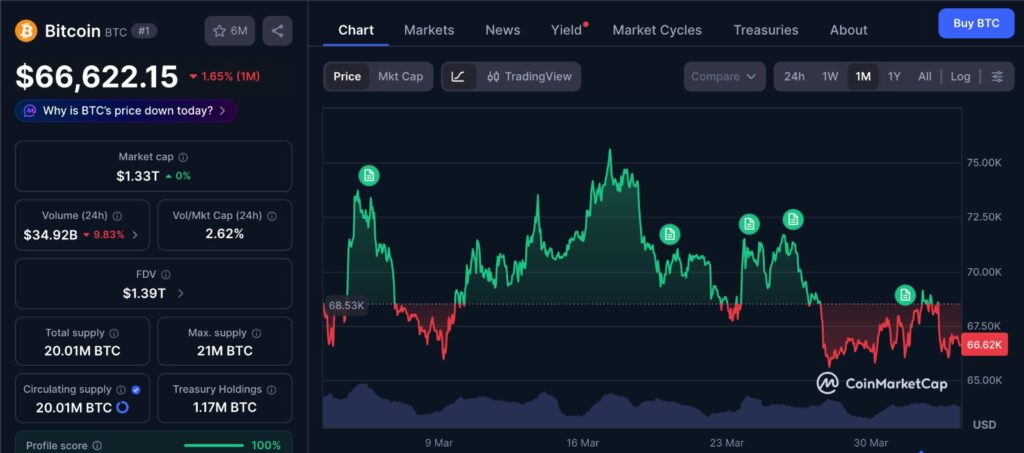
The chart reflects sequencing rather than randomness. Periods of low volatility correspond to phases where liquidity is structured and exposed. When expansion occurs, price is not reacting, it is moving through conditions that were already established.
Crypto Market Makers and Stop-Loss Clusters
Stop-loss clusters represent one of the most reliable sources of executable liquidity. Retail participants tend to anchor risk around visible levels, range highs, lows, and technical boundaries. These areas concentrate future market orders.
For market makers, this is not passive information – it is an actionable structure.
By guiding price toward these zones, they access a predictable flow. Triggered stops and liquidations provide both direction and volume, allowing large positions to be executed without requiring organic participation.
Liquidity is rarely discovered – it is accessed where it is forced to appear.
This is why price often accelerates immediately after key levels break. The move is not driven by conviction; it is driven by positioning being unwound.
The Difference Between Movement and Intent
Price movement is often misinterpreted as intent. A breakout is seen as strength, a breakdown as weakness. But in many cases, movement reflects structural imbalance rather than directional belief.
Market makers are not always expressing a view on price direction. Their role is to facilitate flow under controlled conditions. When those conditions align, price moves, not because someone chose a direction, but because resistance is no longer sufficient.
Markets do not move because participants agree – they move because one side cannot continue.
How This Changes Market Interpretation
Understanding timing changes how market behavior is read. Instead of reacting to price, the focus shifts to identifying when price is able to move.
This reveals:
- Why trends often begin after extended inactivity
- Why breakouts feel delayed but resolve quickly
- Why volatility clusters into sharp expansions rather than gradual shifts
It also highlights a structural asymmetry. This asymmetry is closely tied to how liquidity is distributed across Bitcoin’s order book, where visible depth often overstates actual executable liquidity, as discussed in Bitcoin liquidity depth signals. Most participants engage during expansion, when liquidity is already being consumed. By that point, the conditions that enabled the move have already been exploited.
The edge is not in predicting direction – it is in recognizing when movement becomes unavoidable.
Editor’s View: Market Timing Reveals Who Is Actually In Control
What appears as randomness is often the result of structured conditions being released at specific moments. Most participants are reacting to visible price changes, but the real decisions occur during the quiet phases where positioning becomes crowded and fragile. Timing, in this sense, is a form of control over participation, determining who gets filled under favorable conditions and who is forced to act when liquidity disappears. By the time price expands, the imbalance has already been engineered.
Conclusion: Timing Is the Market’s Hidden Mechanism
Market structure is not defined by where price trades, but by when it is allowed to move. Liquidity, positioning, and execution constraints interact to create windows where movement becomes possible and periods where it is deliberately delayed. Crypto market makers operate within these constraints, shaping timing rather than dictating direction. Understanding this shifts the focus from reacting to price toward recognizing the conditions that make price movement inevitable.
Suggested Links
Keep yourself updated with the latest crypto analysis with Blockbuzzed
Keep yourself updated with the latest news around Bitcoin with Blockbuzzed

