

Ethereum staking impact is not just a reduction in available supply, it is a shift in how supply participates in price formation. When ETH is staked, it transitions from active inventory into inactive capital that no longer competes in the order book. This creates a structural divide between what exists and what can actually respond to market pressure. Over time, that divide compresses liquidity in ways that are not immediately visible through headline metrics. The result is a market that appears deep on-chain but behaves like a thinner system when price begins to move.
Total Supply vs Tradable Supply
Ethereum’s total supply is widely tracked because it is easy to measure, but price discovery does not occur against total supply. It occurs against the subset of supply that is willing and able to transact at current levels.
Staked ETH sits outside that process. It is not continuously repriced through bids and offers, and it does not contribute to the immediate balancing of buyers and sellers. Instead, it becomes delayed supply, present in theory, but absent in execution.
This is where the structural distortion begins. Market participants anchor to total supply while trading against a much smaller effective float. The difference between those two is where unexpected price behavior emerges.
Over the past week, price action has shown periods where Ethereum moved through levels with relatively little resistance, despite no clear surge in broad demand. This is consistent with a market operating on reduced active supply rather than increased participation.
Staking Creates Structural Illiquidity
Staking removes supply in a way that is not dependent on sentiment or short-term positioning. Unlike liquidity that disappears during uncertainty, staked ETH is removed regardless of market conditions.
This creates a system where liquidity is less elastic. When demand increases, supply cannot expand quickly to meet it. When selling pressure appears, there is less standing liquidity to absorb it.
Recent sessions have shown that when price begins to accelerate, it often does so in a way that suggests limited opposing flow rather than overwhelming conviction. This is a key distinction. The market is not always moving because one side is dominant, it is often moving because the other side is absent.
Price doesn’t move because demand is strong – it moves because supply isn’t there to resist it.
Why Price Moves With Less Capital
As tradable supply tightens, the capital required to shift price declines. This changes how moves are interpreted.
Retail participants often associate sharp price action with strong directional conviction. In reality, sharp moves frequently occur in conditions where the order book is thin and liquidity is unevenly distributed.
Price doesn’t react to how much ETH exists — it reacts to how much ETH is actually for sale, a dynamic closely tied to how liquidity is distributed across the market, similar to what is seen in Bitcoin liquidity depth signals
Current market conditions suggest that Ethereum is increasingly sensitive to marginal flows. When a relatively small amount of capital interacts with a constrained supply base, price must adjust further to find equilibrium.
This is not a signal of strength or weakness on its own. It is a reflection of how the market clears when fewer participants are actively providing liquidity.
What appears as momentum is often just the market discovering how little inventory is actually available.
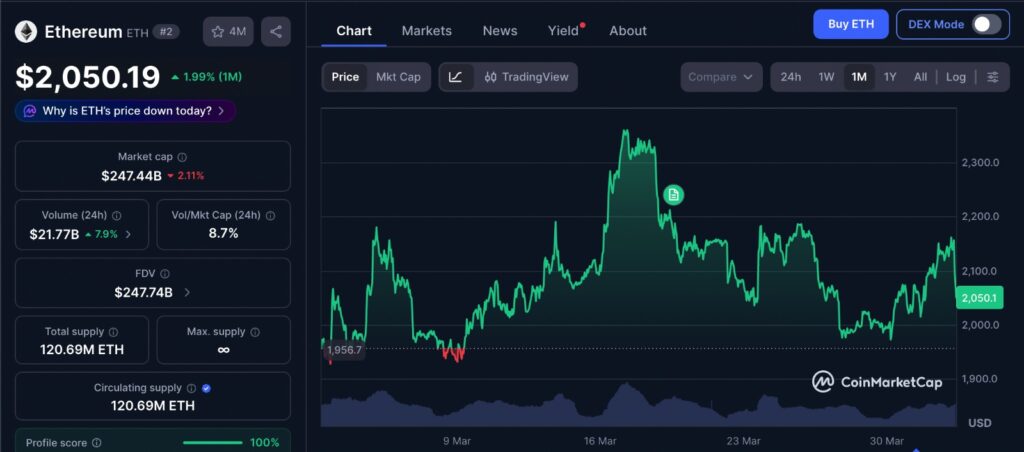
The recent price behavior of Ethereum reflects this dynamic clearly. Over the past month, price has moved through certain levels with a speed that suggests limited resting liquidity rather than broad participation. This aligns with the structural impact of staking, where a portion of supply remains outside immediate circulation, leaving the active market more sensitive to incremental positioning changes.
The Illusion of High Supply
Ethereum continues to be perceived as a highly liquid asset, but that perception is increasingly disconnected from how supply is distributed across time horizons.
A growing portion of ETH is held in forms that are not responsive to short-term price movements. This creates a mismatch between perceived supply and functional supply.
Participants see a large supply base and assume depth. The market, however, operates on the portion of supply that is actually available to transact.
This mismatch becomes visible when price moves further than expected under seemingly normal conditions. The explanation is not always increased demand, but reduced resistance.
Institutional Behavior Around Staked ETH
Institutional participants do not treat all ETH as interchangeable. They separate holdings based on function: trading inventory, collateral, and long-term capital.
Staked ETH typically falls into the category of capital that is intentionally removed from active trading decisions. It is not deployed in response to every price move, which reduces the amount of supply available for execution.
This creates a layered liquidity structure. The visible supply on-chain includes both active and inactive capital, but only a portion of it participates in price discovery.
From an execution standpoint, this changes how market makers operate. When spot liquidity is thinner due to inactive supply, quoting tight markets becomes riskier. Market makers rely on the ability to hedge and recycle inventory efficiently, and when that flexibility is reduced, they begin controlling not just price levels but the timing of when movement becomes viable – a dynamic explored in crypto market makers control timing. If available supply is limited, the cost of providing liquidity increases.
This leads to wider effective spreads and more sensitivity to directional flow. Retail participants often interpret the resulting moves as strong conviction. In reality, they are frequently the result of increased execution risk in a thinner market.
Structural Impact on Market Behavior
Ethereum’s staking model is gradually shifting the market toward one where price is determined by marginal flows interacting with a constrained float. This same constraint-driven movement is also visible during periods of capital rotation, where flows shift across assets not because of changing conviction, but because certain parts of the market are easier to move, as seen in altcoin rotation signals.
This has several effects. Moves can extend further because there is less immediate supply to absorb them. Reversals can occur abruptly because the same thin structure that allows price to move quickly offers limited stability once flows change.
The key mechanism is imbalance. When supply is less responsive, even small differences between buyers and sellers can produce outsized effects.
Over time, this changes how positioning matters. Traders who control liquid inventory gain more influence over short-term price behavior, while long-term holders and stakers exert influence more indirectly by reducing available supply.
Editor’s View:
Staking is often framed as a supply reduction narrative, but its more important effect is how it redistributes control over price. As more ETH moves into staking, fewer participants remain responsible for absorbing and providing liquidity. This concentrates short-term influence into a smaller segment of the market. Price becomes less about broad agreement and more about how that smaller group interacts under constrained conditions. Understanding Ethereum now requires focusing less on how much exists and more on who is still active.
Conclusion
Ethereum’s staking model has introduced a structural shift in how supply interacts with price. The market is no longer defined by total supply, but by the fraction of supply that remains active within the trading environment. This reduces liquidity elasticity and increases sensitivity to marginal flows, making price behavior appear sharper and less predictable under normal conditions. The deeper implication is not directional, but mechanical: Ethereum is evolving into a market where availability matters more than abundance, and where price reflects the constraints of participation rather than the scale of supply.
Suggested Links
Keep yourself updated with the latest crypto analysis with Blockbuzzed
Keep yourself updated with the latest news around Ethereum with Blockbuzzed

