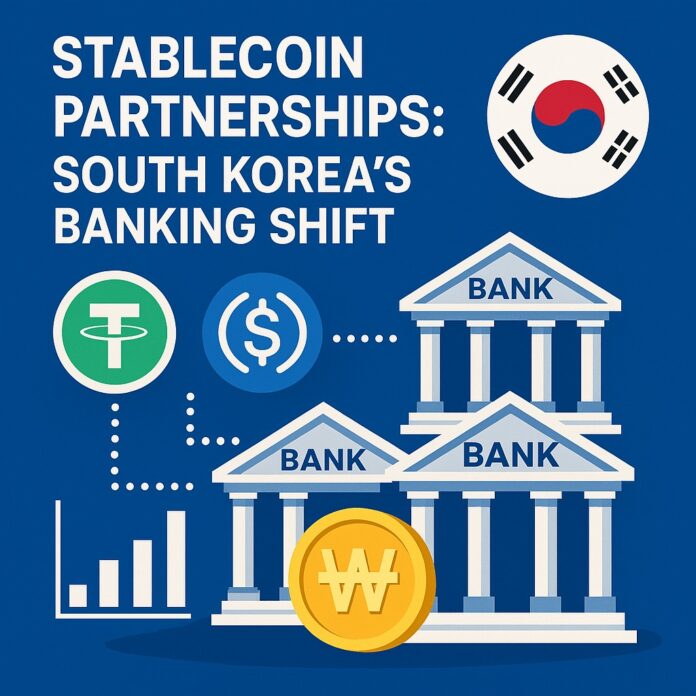
Stablecoin Partnerships are reshaping South Korea’s financial industry as the nation’s leading banks step into the digital asset space. Executives from Shinhan, Hana, KB Financial, and Woori are preparing to meet with Tether and Circle, the companies behind USDT and USDC. These discussions aim to explore how banks can participate in distributing stablecoins domestically and potentially issuing a Korean won-pegged digital token. The move signals a new era for the intersection of traditional finance and blockchain.
Stablecoin Partnerships: South Korea’s Banking Shift
The banking sector in South Korea has long been known for its innovation, and the interest in stablecoin partnerships underscores a forward-looking strategy. Meetings scheduled between bank executives and stablecoin issuers suggest that large-scale financial institutions are no longer ignoring crypto markets. Instead, they are actively looking for structured ways to integrate digital assets into their services.
According to reports, Shinhan Financial Group CEO Jin Ok-dong and Hana Financial Group CEO Ham Young-joo will meet Circle’s president Heath Tarbert to discuss opportunities. Later the same day, Hana’s CEO will also meet with a Tether executive. Meanwhile, KB Financial Group’s chief digital and IT officer, Lee Chang-kwon, and Woori Bank president Jeong Jin-wan have arranged talks with Circle. Though specific agendas are not public, the focus remains on distribution and potential issuance of stablecoins.
These meetings highlight South Korea’s ambition to secure a leading role in shaping the global stablecoin economy.
Why Stablecoin Partnerships Matter
Stablecoin partnerships are significant for several reasons. First, they represent a bridge between traditional banking and cryptocurrency adoption. USDT and USDC are already the most widely used stablecoins worldwide, providing liquidity and settlement solutions in global crypto markets. Their official entry into South Korea through regulated banks would add legitimacy and expand their reach.
Second, there is growing domestic demand for stable digital assets. Many South Korean investors and businesses already use stablecoins informally to manage currency exposure or participate in global markets. Partnerships with banks could formalize and regulate this activity, providing more security for users while giving institutions a share in the market.
Finally, the issuance of a won-pegged stablecoin could strengthen South Korea’s financial independence. Instead of relying exclusively on dollar-based stablecoins, the country could create its own digital asset tied directly to the local currency, ensuring stability and regulatory oversight.
Stablecoin Partnerships and Government Support
The timing of these talks is not accidental. President Lee Jae Myung, who took office with a pro-crypto stance, promised during his campaign to develop a stablecoin market anchored in the Korean won. His administration has repeatedly emphasized the need to modernize financial services and support blockchain innovation.
The government’s financial regulator, the Financial Services Commission (FSC), is currently drafting a comprehensive framework for stablecoins, expected to be released by October. This framework will address rules for issuance, distribution, custody, and user protection. Such regulation is likely to provide banks with clarity and confidence to move forward with their stablecoin plans.
Recent coverage by Yonhap News Agency also highlights how policymakers are examining digital finance strategies to ensure South Korea maintains competitiveness in the global market (https://en.yna.co.kr/view/AEN20250821006400320). This aligns with the push from both banks and regulators to integrate stablecoins responsibly into the financial system.
The support from both political leadership and regulators aligns perfectly with the banks’ growing interest. Together, they could create one of the world’s most robust national stablecoin ecosystems.
Strategic Implications of Stablecoin Partnerships
When analyzing the impact of these partnerships, two main strategies stand out:
Distribution of USDT and USDC
Stablecoin distribution would allow South Korean banks to serve as official channels for purchasing and redeeming USDT and USDC. This could transform how investors and businesses interact with digital assets, offering regulated access and reducing reliance on offshore exchanges. It would also align with global moves to regulate fiat-backed tokens more closely.
Issuance of Won-Pegged Stablecoins
A domestic stablecoin tied to the Korean won could revolutionize payment systems. It would enable faster and cheaper digital transactions, support cross-border trade, and potentially compete with credit card networks for local commerce. The presence of major banks would ensure trust and liquidity, while regulatory oversight would mitigate risks.
Both strategies carry global implications. If South Korea’s banks succeed, other nations may follow their model, especially in regions where central bank digital currency projects have slowed or stalled.
Regulatory Landscape and Stablecoin Partnerships
Regulation will play a decisive role in determining the success of these partnerships. The FSC’s upcoming framework is expected to set standards for reserve management, transparency, and compliance. This will ensure that stablecoins used in South Korea meet strict requirements for security and accountability.
It is worth noting that earlier this year, the Bank of Korea suspended its central bank digital currency project. This shift leaves room for private-sector stablecoins, supported by banks, to lead the digital currency charge. Instead of competing directly with a government-issued CBDC, banks now have an opportunity to innovate within a regulated but open market environment.
Market and Industry Reactions
Industry watchers believe these moves could mark a turning point for South Korea. Stablecoin partnerships between global issuers and local banks would not only provide domestic stability but also connect the country more deeply with international financial flows. Exchanges, fintech startups, and payment providers are likely to integrate with bank-backed stablecoins, expanding usage beyond trading and into everyday commerce.
For global companies like Tether and Circle, partnerships with South Korea’s largest banks would provide access to one of the world’s most active crypto markets. The trust and scale offered by Shinhan, Hana, KB, and Woori could accelerate adoption and reinforce their positions as leading stablecoin issuers.
Conclusion: Stablecoin Partnerships at a Crossroads
Stablecoin Partnerships in South Korea reflect a broader transformation of finance. The planned meetings between banking executives and Tether and Circle represent more than business opportunities—they symbolize a new alignment between traditional financial institutions and digital currency innovators. With regulatory clarity on the horizon and government backing in place, South Korea may soon emerge as a global leader in stablecoin adoption.
If the initiatives succeed, South Korean banks could distribute dollar-based stablecoins like USDT and USDC while also issuing a homegrown won-pegged token. This dual approach would position the country as a pioneer in integrating global and domestic stablecoins into a regulated banking system. The outcome will influence not only South Korea’s economy but also the future direction of global digital finance.
Suggested Links
Keep yourself updated with the latest crypto analysis with Blockbuzzed
Keep yourself updated with the latest news around Altcoins with Blockbuzzed
Keep yourself updated with the latest news around memecoins with Blockbuzzed
Keep yourself updated with the latest news around Ethereum with Blockbuzzed
Keep yourself updated with the latest news around Bitcoin with Blockbuzzed

