
Ethereum supply shock discussions are heating up as key indicators point to dwindling ETH availability across exchanges. With rising outflows, staking lockups, and ongoing token burns, the crypto community is buzzing about whether this tightening supply could drive the next significant price rally for Ethereum.
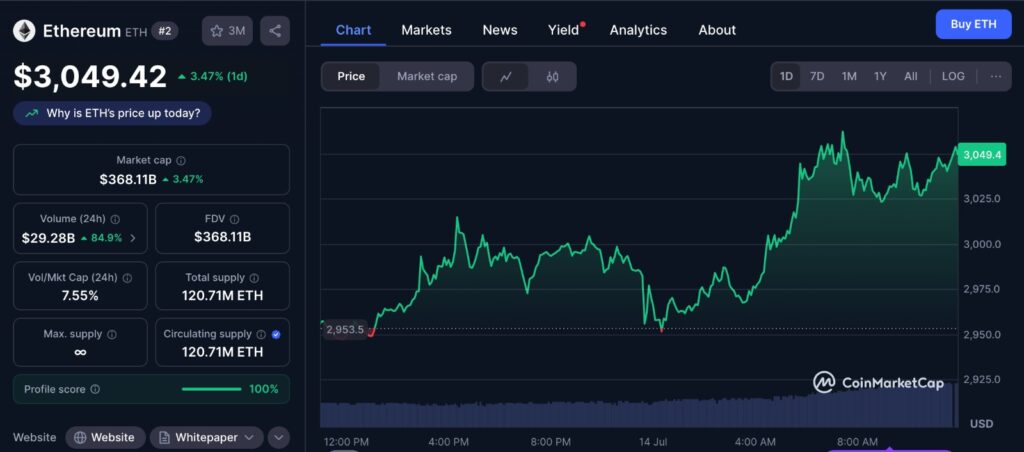
The chart above from CoinMarketCap offers a visual look at Ethereum’s current price action, reflecting the market dynamics contributing to the ongoing Ethereum supply shock. As ETH’s circulating supply continues to tighten due to staking and burning, traders and investors are watching price trends closely for signs that this scarcity could translate into the next major price rally.
Let’s explore what’s behind this phenomenon and how it could impact ETH’s future trajectory.
1. What is an Ethereum Supply Shock?
An Ethereum supply shock occurs when the available supply of ETH shrinks, while demand either remains stable or increases. This imbalance can drive prices upward because:
- Fewer coins are available for traders and investors to buy.
- Sellers may hold out for higher prices, creating upward pressure.
- Market participants anticipate scarcity, which can fuel speculative buying.
Unlike Bitcoin’s fixed supply halving events, Ethereum’s supply dynamics are now increasingly influenced by its transition to proof-of-stake and its burn mechanism.
2. Staking Reduces Circulating ETH
Ethereum’s shift to proof-of-stake has fundamentally altered supply behavior:
- Over 30 million ETH is now staked, effectively removing these coins from liquid circulation.
- Staking participation has grown steadily as yields remain attractive, further constraining available supply.
- Validators are incentivized to keep their ETH locked to earn staking rewards.
This has become a significant driver of the ongoing Ethereum supply shock, tightening market liquidity for active trading.
3. The Burn Mechanism Intensifies Scarcity
A major factor fueling Ethereum’s reduced supply is EIP-1559, implemented during the London upgrade:
- A portion of transaction fees is permanently burned with every transaction.
- During periods of network activity spikes, burn rates increase dramatically.
- This has occasionally made ETH deflationary over short periods.
Combined with staking, Ethereum’s burn mechanism is shrinking the circulating supply, supporting the Ethereum supply shock narrative.
4. Exchange Balances Hit Multi-Year Lows
Data from on-chain analytics shows that ETH balances on centralized exchanges are at their lowest levels in years:
- Investors are moving ETH into cold storage or staking rather than leaving it on exchanges.
- Reduced exchange balances signal confidence and long-term holding behavior.
- Lower available liquidity on exchanges can magnify price movements during periods of volatility.
These trends are strong evidence of the current Ethereum supply shock gaining momentum.
5. What Does This Mean for Ethereum’s Price?
The implications of the Ethereum supply shock for price action are significant:
- A constrained supply can create sharp upward moves if demand rises suddenly.
- Market sentiment is leaning bullish, with many traders eyeing potential new highs for ETH.
- However, price still depends on broader factors like macroeconomic conditions, regulatory news, and crypto market trends.
Investors should remain cautious, remembering that while supply shocks support bullish narratives, they do not guarantee immediate price surges.
6. Risks and Counterpoints
Despite the bullish case, there are caveats:
- Regulatory uncertainty continues to hover over crypto markets, which could dampen demand.
- Staked ETH may eventually unlock and return to circulation, particularly if price incentives change.
- Broader economic factors like interest rate policies or global market instability could limit capital flows into crypto.
Even amid an Ethereum supply shock, these risks could slow or reverse price advances.
Final Take
The current Ethereum supply shock underscores a fundamental shift in ETH’s market structure. Between staking, token burns, and declining exchange balances, Ethereum’s circulating supply is tightening like never before. While this creates a strong backdrop for potential price growth, investors should remain realistic about crypto’s inherent volatility and external market forces.
Whether the supply crunch leads to new all-time highs or remains just another bullish narrative will depend on how demand evolves in the coming months. One thing is clear: Ethereum’s dynamics are changing, and the market is watching closely.
Suggested Links
Keep yourself updated with the latest crypto analysis with Blockbuzzed
Keep yourself updated with the latest news around Altcoins with Blockbuzzed
Keep yourself updated with the latest news around memecoins with Blockbuzzed
Keep yourself updated with the latest news around Ethereum with Blockbuzzed
Keep yourself updated with the latest news around Bitcoin with Blockbuzzed

