
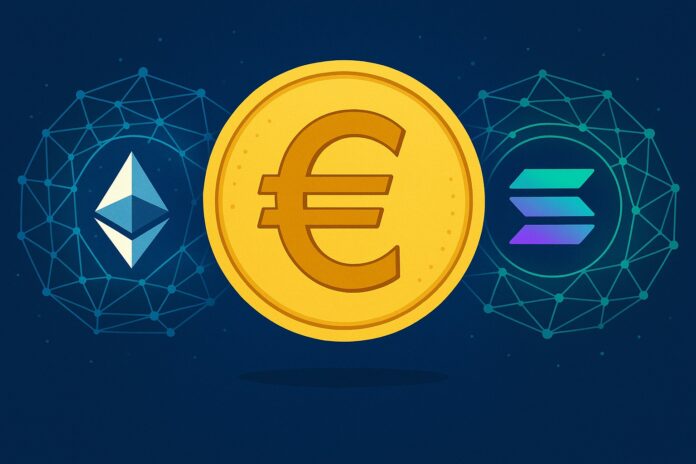
Digital Euro is entering a decisive stage as European policymakers explore whether the European Central Bank’s planned central bank digital currency should run on public blockchains such as Ethereum and Solana. This possibility represents a major departure from earlier discussions that focused on permissioned systems controlled by central institutions.
Early Steps Toward the Digital Euro
The European Central Bank (ECB) has been working on the Digital Euro project for several years. Its primary aim is to ensure that the euro remains strong and relevant in the age of digital money. The Digital Euro is designed to complement cash and existing bank deposits rather than replace them. It would provide citizens with a new, secure, and efficient way to pay, whether online or offline, and preserve trust in the euro across member states.
The ECB has already conducted investigations, consultations, and preliminary experiments. In late 2023, the bank moved into the preparation phase, which will last until 2025. By the end of this phase, officials are expected to decide whether to move forward with a launch. Until recently, the assumption was that the Digital Euro would rely on closed, permissioned systems. Now, however, European institutions are openly considering public blockchains like Ethereum and Solana.
Why Public Blockchains Are Being Considered
Historically, central banks have avoided public blockchains because of concerns over control, governance, and security. China’s digital yuan, for example, operates entirely on state-managed infrastructure. The European Union is breaking with this precedent by considering open systems. Sources indicate that Ethereum and Solana have been discussed as potential hosts for the Digital Euro infrastructure.
Benefits of a Public Blockchain Digital Euro
There are several potential advantages to using a public blockchain for the Digital Euro:
- Interoperability: Ethereum and Solana already host thriving ecosystems of decentralized applications. Launching the Digital Euro on these platforms could ensure instant compatibility with a wide range of financial services, wallets, and payment solutions.
- Innovation: A public blockchain would allow developers across Europe and beyond to build directly on top of the Digital Euro, spurring new business models in payments, lending, and commerce.
- Transparency and trust: Transactions on public blockchains are verifiable and immutable, reinforcing trust in the system.
- Speed and scalability: Solana is known for its high throughput, processing thousands of transactions per second. Ethereum, while slower, has the most mature developer ecosystem and is steadily scaling through upgrades.
- Strategic sovereignty: By anchoring the euro in public blockchain infrastructure, Europe could strengthen its independence from foreign-controlled payment systems.
Risks and Challenges
Despite the potential, adopting public blockchains for the Digital Euro is not without risks:
- Privacy: Public blockchains record transactions on transparent ledgers. While this increases accountability, it also raises concerns about user privacy. The ECB has emphasized that Digital Euro payments should not be fully traceable by commercial entities, which may require additional privacy layers.
- Governance: Ethereum and Solana are open networks with decentralized governance. Aligning their operations with central bank control could create tension, particularly if network rules evolve independently of ECB oversight.
- Security: While major blockchains are battle-tested, they remain vulnerable to technical failures or attacks. A Digital Euro running on these systems would require additional safeguards.
- Political acceptance: Member states may hesitate to endorse a model that places a sovereign currency on infrastructure not directly controlled by the EU.
Geopolitical Pressures Driving the Decision
The renewed interest in public blockchain stems partly from global competition. In the United States, stablecoins backed by the dollar are rapidly growing. With new legislation regulating stablecoins, such as the GENIUS Act, U.S. dollar-backed tokens are becoming more dominant worldwide. This raises fears that the euro could lose ground if Europe does not act quickly.
By launching a Digital Euro that integrates with the open blockchain economy, Europe hopes to secure its financial sovereignty. The move also aligns with the EU’s Markets in Crypto-Assets (MiCA) regulation, which creates a clear framework for digital assets. A Digital Euro on Ethereum or Solana would send a strong signal that Europe intends to lead, not follow, in the global competition for digital finance.
The Road Ahead for the Digital Euro
The current preparation phase will conclude in 2025. By then, the ECB’s Governing Council is expected to decide whether to proceed with issuing the Digital Euro. If approved, development could take several more years, with a possible launch in the second half of the decade. Technical testing, privacy solutions, and regulatory fine-tuning will all be essential before deployment.
Balancing Innovation and Control
The key challenge is finding a balance between innovation and control. A public blockchain Digital Euro could unlock enormous opportunities for European startups, fintechs, and citizens. But it also raises delicate questions about sovereignty, privacy, and governance. Officials must ensure that the currency remains secure, widely usable, and consistent with Europe’s values.
Conclusion: A Bold Step for Europe
The decision to consider Ethereum and Solana as possible foundations for the Digital Euro marks a bold departure from tradition. If the project goes forward, Europe would become the first major economic bloc to issue a central bank digital currency on public blockchains. This would redefine how money works in the eurozone, blending state-backed trust with the openness of decentralized technology.
Still, caution is necessary. Privacy protections must be robust, and central bank oversight cannot be compromised. If these challenges can be addressed, the Digital Euro may emerge as one of the most significant innovations in the history of European finance. The world will be watching closely as the ECB prepares to make its decision in 2025.
Suggested Links
You can read more about it here
Keep yourself updated with the latest crypto analysis with Blockbuzzed
Keep yourself updated with the latest news around Altcoins with Blockbuzzed
Keep yourself updated with the latest news around memecoins with Blockbuzzed
Keep yourself updated with the latest news around Ethereum with Blockbuzzed
Keep yourself updated with the latest news around Bitcoin with Blockbuzzed

