
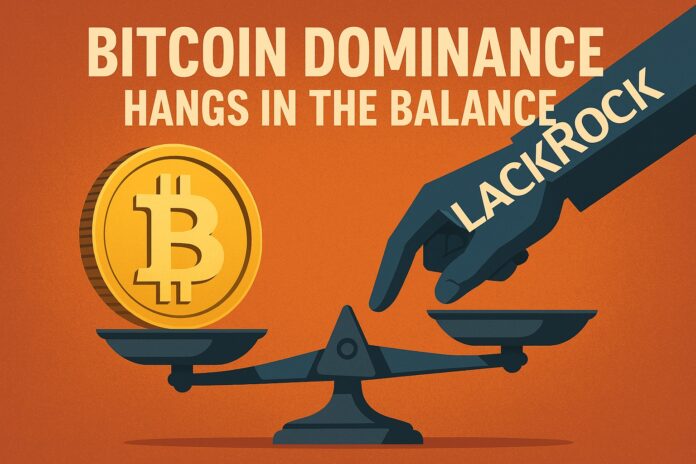
Bitcoin dominance is facing a pivotal challenge as institutional influence deepens in the cryptocurrency ecosystem. With BlackRock having acquired a 5 percent stake in Strategy (formerly MicroStrategy), concerns are mounting over the long-term integrity of decentralized finance and Bitcoin’s future as “the people’s money.”
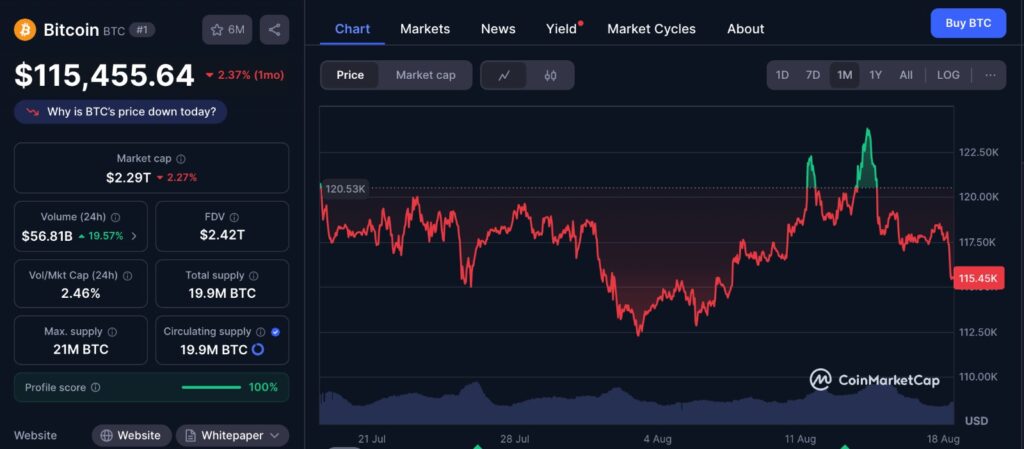
Over the past month, Bitcoin’s price has shown heightened volatility, as reflected in the chart above. Despite reaching new all-time highs earlier, the market has been consolidating with sharp swings in both directions. This price action underscores the uncertainty surrounding Bitcoin dominance, especially as institutional players like BlackRock expand their footprint. The one-month trend highlights how sensitive BTC remains to both macroeconomic conditions and major corporate moves, reinforcing concerns about whether Bitcoin’s future will be driven by decentralization or Wall Street influence.
Bitcoin dominance and BlackRock’s expanding crypto footprint
How BlackRock is boosting its crypto muscle
Bitcoin dominance comes under direct pressure from BlackRock’s growing presence in the market through both Bitcoin and Ethereum ETFs. The firm’s iShares Ethereum Trust (ETHA) recently recorded a historic inflow of $1.019 billion on August 11, pushing its total assets under management above $10 billion. At the same time, the iShares Bitcoin Trust (IBIT) surged past $91 billion in AUM, boosted by Bitcoin’s climb to a record $124,500. These developments show how BlackRock has quickly evolved from being a passive market participant into a major force with the ability to steer overall sentiment and liquidity.
This is not a small shift. In traditional markets, BlackRock is already known for managing trillions in global assets. Its entry into crypto at such scale represents more than just portfolio diversification. It introduces systemic influence, where one institution’s decisions may ripple across an industry that was originally built to avoid such concentration of power.
Linking major whales: BlackRock and Michael Saylor’s Strategy
The link between BlackRock and Strategy is now impossible to ignore. By securing a 5 percent equity stake in Strategy, BlackRock has positioned itself close to one of the biggest private Bitcoin treasuries in existence. Michael Saylor’s company holds well over 200,000 BTC, funded largely through leveraged debt issuance and stock dilution. This makes Strategy a unique whale in the crypto market: large, visible, and highly dependent on market confidence.
BlackRock’s stake may seem modest at 5 percent, but it grants a level of access and influence that could matter in times of crisis. If Strategy faces pressure, whether from debt obligations, market volatility, or declining stock prices, its dependence on Bitcoin could turn into a vulnerability. That vulnerability is now within reach of one of the world’s most powerful financial institutions.
Bitcoin dominance at risk: market manipulation scenarios
Potential cascade trigger points
Analysts warn of troubling possibilities if market stress builds. If Strategy’s stock were to come under sustained pressure, management might be forced to liquidate Bitcoin holdings to cover financial obligations. In June, Strategy transferred 7,382 BTC worth roughly $850 million to Coinbase Prime, an unusual move for a company that has consistently promoted its long-term holding strategy. This could suggest preparation for potential sales.
At nearly the same time, BlackRock offloaded more than $500 million worth of Bitcoin within 48 hours. Though not a massive percentage of its total assets, the timing sparked speculation that coordinated actions could trigger cascading market reactions. A forced sell-off by Strategy could flood the market with liquidity, drive prices downward, and create panic among retail investors.
Projections from bearish scenarios suggest Bitcoin could fall sharply toward the $65,000 to $60,000 range, dragging Ethereum down to the $1,700 mark. In such conditions, altcoins could be devastated, with losses reaching 80 to 90 percent. Derivatives platforms might freeze, exchanges could halt withdrawals, and retail traders, many of whom entered near recent highs, could capitulate in large numbers.
Monopoly versus decentralization
The larger concern is not just short-term volatility but the long-term shift in market structure. Bitcoin dominance has historically represented decentralized confidence in the world’s first cryptocurrency. If a single institution like BlackRock ends up indirectly controlling both ETF flows and a whale like Strategy, it raises the possibility of a centralized monopoly over Bitcoin supply.
Crypto was designed to resist exactly this kind of capture. But as institutional funds accumulate more BTC and retail investors panic-sell during downturns, the balance of power could tilt in favor of large asset managers. This would undermine the very principle of decentralization that Bitcoin was built on.
Bitcoin dominance implications for the broader crypto ecosystem
Institutional accumulation under crisis shadow
Another troubling outcome could be the silent accumulation of assets by institutional giants during crises. As smaller investors panic, institutions can step in to buy at depressed levels, consolidating control. This dynamic, while rational from a market perspective, shifts wealth and ownership away from the grassroots communities that helped establish crypto in the first place.
It also creates an ethical dilemma. While Bitcoin’s open market ensures everyone has access, the practical outcome is that retail fear becomes institutional opportunity. Over time, this could reshape Bitcoin’s narrative from being “the people’s money” to a tool managed by financial elites.
Redefining Bitcoin as a financial instrument
This shift in ownership patterns is already changing Bitcoin’s identity. No longer seen purely as a decentralized alternative to fiat money, Bitcoin increasingly behaves like a traditional asset. It is collateralized, securitized, and traded through ETFs in ways similar to gold or oil. While this broadens mainstream access, it also risks turning Bitcoin into yet another instrument dominated by Wall Street.
If this trend continues, Bitcoin dominance could lose its symbolic power as a decentralized force. The more it becomes a corporate-controlled asset, the less it resembles the revolutionary idea that ignited its creation.
Bitcoin dominance in jeopardy: what’s at stake now?
Bitcoin dominance hangs in the balance at a moment when it faces existential questions. Strategy’s stock, which recently slipped 1.78 percent to $366.32, demonstrates how fragile the system can be when one company’s fortunes are tied so closely to the fate of the largest cryptocurrency. With BlackRock’s stake linking traditional finance and one of Bitcoin’s largest holders, the potential for manipulation, whether intentional or not, has never been higher.
The question now is whether Bitcoin will continue as a decentralized, community-driven alternative to traditional finance, or whether it will be absorbed into the very system it was meant to disrupt. BlackRock’s moves do not just impact market prices; they could reshape the future of crypto itself.
For investors and enthusiasts alike, the debate comes down to values as much as valuation. Is Bitcoin’s greatest strength its price action, or its ability to remain free from centralized control? The answer will determine whether Bitcoin dominance survives or fades into a Wall Street narrative.
Suggested Links
Keep yourself updated with the latest crypto analysis with Blockbuzzed
Keep yourself updated with the latest news around Altcoins with Blockbuzzed
Keep yourself updated with the latest news around memecoins with Blockbuzzed
Keep yourself updated with the latest news around Ethereum with Blockbuzzed
Keep yourself updated with the latest news around Bitcoin with Blockbuzzed

